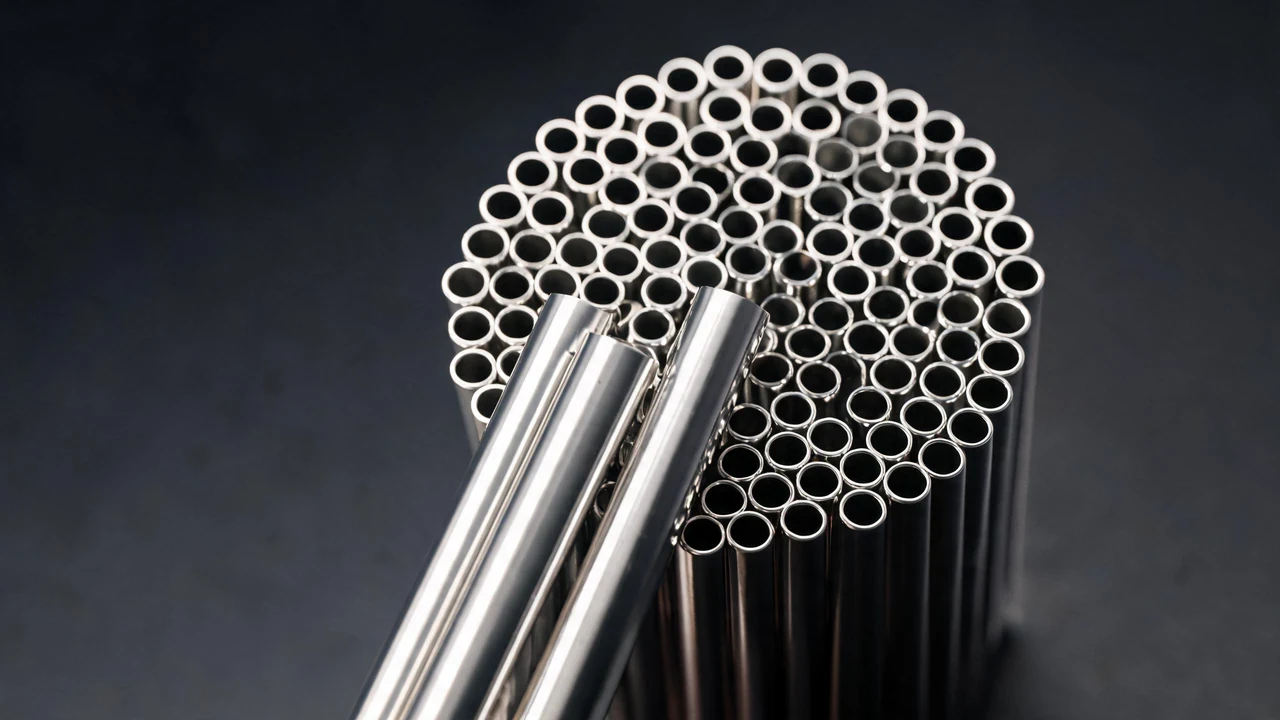
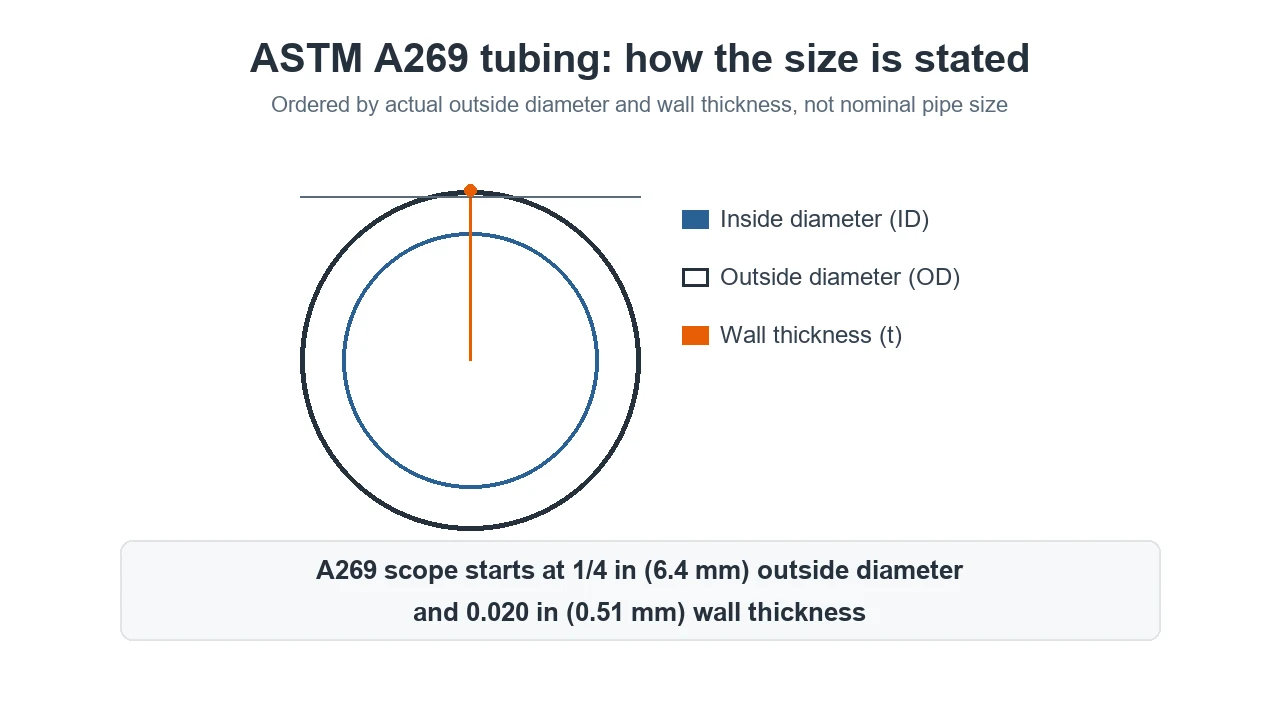
ASTM A269 covers seamless and welded austenitic stainless steel tubing for general corrosion-resisting and low- or high-temperature service, supplied solution annealed. The grades ordered most often are TP304, TP304L, TP316 and TP316L, with minimum tensile strengths of 515 MPa (75,000 psi) for the standard grades and 485 MPa (70,000 psi) for the low-carbon L grades. The specification is written for small-diameter, thin-wall tubing: its scope starts at 1/4 inch (6.4 mm) outside diameter and 0.020 inch (0.51 mm) wall thickness, and it is ordered by actual outside diameter and wall rather than by nominal pipe size.
Download ASTM A269 Stainless Steel Tubing data sheet (PDF) One-page summary of the supply range, chemistry, mechanical properties and inspection documents on this page. The standard is the governing document.
Mejor Steel is the export agent for the mills that make your material: one contract, one delivery date, and the mill named on the quotation. How we supply
We reply within one business day, Monday to Friday 09:00-18:00 CST. Or write to info@mejorsteel.com / WhatsApp.
Size range and specification
- Outside diameter 1/4 in (6.4 mm) and larger, to the size fixed on the order
- Wall thickness 0.020 in (0.51 mm) and larger
- Length Straight lengths or coils, cut to the ordered length
- Ends Plain end, cut square, or as specified
- Surface finish Annealed and pickled, bright annealed, or as specified
- Manufacturing process Seamless or welded
- Heat treatment Solution annealed
- Delivery standard ASTM A269 / A269M
- Delivery condition Annealed
A269 sizes are stated as an outside diameter plus a wall thickness, and the two together fix the inside diameter. The cross-section below shows how the three measurements relate.
How this tubing is supplied
- Inspection Inspected by the producing mill’s own inspection department, which is independent of production, against the delivery standard above. Third-party inspection — SGS, BV or TUV, or an inspector you send yourself — can be arranged at the mill or before shipment; give us the dates and the scope at the order stage.
- Certificate A mill test certificate to EN 10204 3.1 showing the heat number, the chemical composition and the mechanical results is standard on every order. EN 10204 3.2, countersigned by the inspector you nominate, is available on request.
- Documents with the goods The mill test certificate and the packing list travel with the shipment, and the heat number is traceable from cast through to the finished product.
- Packing Sea-worthy export packing: bundled by size with end protection, corrosion protection on request, stencilled with the size, grade and heat number.
- MOQ One bundle or one truckload; mixed sizes within a bundle accepted.
- Lead time Counted from order confirmation, not from the enquiry. Stock sizes 5–10 days; mill run or non-stock 3–5 weeks. The delivery window is fixed on the quotation.
- How we supply Sourced through partner mills; the producing mill is named on the quotation.
ASTM A269 chemical composition (%)
| Element | TP304 | TP316 |
|---|---|---|
| Carbon, C | 0.08 max | 0.08 max |
| Manganese, Mn | 2.00 max | 2.00 max |
| Silicon, Si | 0.75 max | 0.75 max |
| Phosphorus, P | 0.045 max | 0.045 max |
| Sulphur, S | 0.030 max | 0.030 max |
| Chromium, Cr | 18.0 – 20.0 | 16.0 – 18.0 |
| Nickel, Ni | 8.0 – 11.0 | 10.0 – 14.0 |
| Molybdenum, Mo | – | 2.00 – 3.00 |
TP304L and TP316L are the same composition with carbon capped at 0.035 percent; for small-diameter or thin-wall tubing that is drawn more than once, the standard permits the low-carbon grades to be supplied at up to 0.040 percent carbon. Chromium forms the passive film that makes the steel stainless, nickel holds the austenitic structure, and the molybdenum in TP316 is what resists pitting and crevice corrosion in chloride-bearing service.
Source: chemical composition requirements of ASTM A269 / A269M. The standard is the governing document.
ASTM A269 mechanical properties
| Grade | Tensile strength | Yield strength | Elongation |
|---|---|---|---|
| TP304 | 515 MPa min (75,000 psi) | 205 MPa min (30,000 psi) | 35% min |
| TP316 | 515 MPa min (75,000 psi) | 205 MPa min (30,000 psi) | 35% min |
| TP304L | 485 MPa min (70,000 psi) | 170 MPa min (25,000 psi) | 35% min |
| TP316L | 485 MPa min (70,000 psi) | 170 MPa min (25,000 psi) | 35% min |
The tensile requirements do not apply to tubing with an inside diameter smaller than 1/8 inch (3.2 mm) or a wall thickness smaller than 0.015 inch (0.38 mm); for those sizes the mechanical values are set by the order. A269 also limits the hardness of the annealed tubing, not exceeding 90 HRB (200 HV) for these austenitic grades, so the annealed condition has to be confirmed on the certificate as well as the grade. Yield strength is the 0.2 percent offset value.
Source: tensile and hardness requirements of ASTM A269 / A269M. The standard is the governing document.
What Is ASTM A269 Tubing?
A269 is a material specification for seamless and welded austenitic stainless steel tubing, supplied solution annealed, for general corrosion-resisting and low- or high-temperature service. It is a tubing specification rather than a pipe specification: the item is ordered by actual outside diameter and wall thickness, not by nominal pipe size and schedule. The common grades are the 304 and 316 families, and the L grades are used where the tubing will be welded and the joint cannot be solution annealed afterwards.
How A269 sits among the stainless tube and pipe specifications
A269 is one of three stainless specifications that are easy to confuse. ASTM A312 is the pipe specification, ordered by nominal pipe size and schedule with dimensions to ASME B36.19M and used for pressure piping. ASTM A213 is the seamless ferritic and austenitic boiler, superheater and heat-exchanger tube specification, with tighter service-specific requirements. A269 sits between them: it is tubing ordered by outside diameter and wall, for general corrosion-resisting and low- or high-temperature service, and it is the specification named most often for instrumentation, hygienic and general process tubing where the heat-exchanger requirements of A213 are not being invoked.
Where A269 tubing is used
A269 tubing is specified where a small-diameter austenitic stainless tube has to carry a fluid cleanly and resist corrosion, but where the item is not a boiler or heat-exchanger tube covered by A213. That puts it in instrumentation, hygienic and general process service.
Typical applications
- Instrumentation impulse and sample lines
- Hygienic and sanitary process tubing
- Pharmaceutical process lines
- Food and beverage process tubing
- General corrosion-resisting process tubing
- Low- or high-temperature service in austenitic stainless
Standards covered
Frequently asked questions
What is the difference between A269 tubing and A312 pipe?
A269 is tubing and A312 is pipe. A269 is ordered by actual outside diameter and wall thickness, while A312 pipe is ordered by nominal pipe size and schedule with dimensions to ASME B36.19M. Both cover austenitic stainless steel in the 304 and 316 families, but the two specifications are written around different product forms and different services, so the order has to name the right one.
What is the difference between A269 and A213?
A213 is the specification for seamless ferritic and austenitic boiler, superheater and heat-exchanger tubes, and it carries the additional service-specific requirements those duties need. A269 is the general corrosion-resisting and low- or high-temperature tubing specification. Where a heat-exchanger tube is being ordered, A213 is normally named instead of A269.
Should I order TP304 or TP316 tubing?
Order TP316 where the fluid contains chlorides, because its 2 to 3 percent molybdenum raises resistance to pitting and crevice corrosion. In chloride-free service TP304 performs just as well and costs less. Both grades carry the same minimum tensile and yield strength.
What does the L in TP304L and TP316L mean?
It means low carbon: 0.035 percent maximum instead of 0.08. The lower carbon reduces carbide precipitation at welded joints, so L-grade tubing can be welded without post-weld solution annealing. The trade-off is strength, because the L grades are specified at 485 MPa minimum tensile and 170 MPa minimum yield against 515 MPa and 205 MPa for the standard grades.
Does A269 tubing carry a pressure rating?
No. A269 is a material specification and does not assign a pressure rating. The pressure capability comes from the design code, the size, the wall thickness and the temperature, and has to be calculated or read from the applicable code rather than assumed from the specification name.
Where to go next
- ASTM A312 TP316 Pipe – the molybdenum-bearing austenitic stainless pipe grade
- ASTM A312 TP304 Pipe – the general-purpose austenitic stainless pipe grade
- Stainless Steel Pipe – grades, standards and how the order is fixed
- Boiler & Heat Exchanger Tube – tube specified by outside diameter and wall
- Boiler Tube vs Heat Exchanger Tube – what actually differs between the two duties
- Steel Pipe Standards & Grades – every grade page in this section
- Get a Quote – send the grade, size, quantity and destination port
Four details and we can quote. The grade or the standard the material has to meet, the size and wall thickness, the tonnage, and the destination port. Send them together and we answer with availability and pricing.
Request a quotation