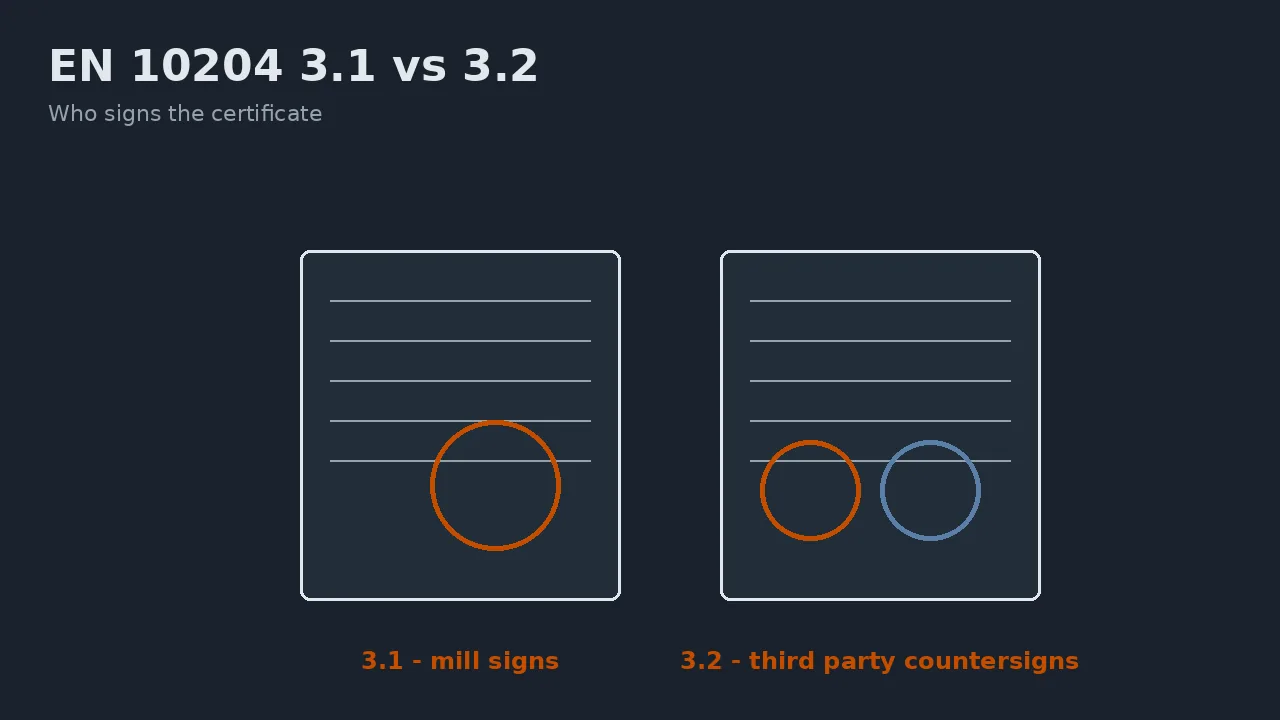
Both are inspection certificates based on specific testing of the products supplied, so the type of test result is the same. What differs is who validates the document. A 3.1 is issued by the manufacturer’s inspection department, independent of manufacturing; a 3.2 carries the additional countersignature of an independent third party.
Which certificate to ask for. Both a 3.1 and a 3.2 are inspection certificates based on specific testing of the products supplied, and both state the results – the step from 3.1 to 3.2 is not a step up in testing. What the 3.2 adds is the countersignature of an independent third party that the purchaser nominates or accepts, and that is the only thing it buys. Specify 3.2 where the project specification, the design code or the end user requires third-party validation, because a 3.1 will simply be rejected there however good the results are; where no such requirement exists, a 3.1 answers the same question about whether the tests were done on this pipe.
What EN 10204 actually covers
EN 10204 is the standard for inspection documents for metallic products. It defines the document types and who may issue them. It does not define which tests are carried out, what the acceptance limits are, or what grade the material must be. Those come from the product standard – API 5L, ASTM A106, EN 10216, whatever the order is placed against.
That separation is the source of most of the confusion around it. A certificate to EN 10204 tells you what kind of document you are holding and who signed it. Whether the steel is suitable is answered by the product standard the certificate references.
The four document types
The 2004 edition of the standard defines four, and they run in order of how much evidence they carry. A 2.1 is a declaration of compliance with the order, with no test results. A 2.2 is a test report, which does carry results but from non-specific inspection, meaning the results need not come from the products actually supplied.
A 3.1 and a 3.2 both rest on specific inspection, which means the tests were performed on the products being certified, and both state the results. That is the important point and it is often missed: the step from 3.1 to 3.2 is not a step up in testing.
Where 3.1 and 3.2 are the same
Both are inspection certificates. Both are based on specific inspection of the actual products. Both state the test results, and both identify the products they cover – the order, the heat or batch, the dimensions, the quantity, and the product standard tested against.
So if the question is whether the tests were done on this pipe or on something from the same heat, 3.1 and 3.2 answer it the same way. The difference lies somewhere else.
The four types side by side
The table below puts the four documents next to each other, which is the quickest way to see that the step from 2.2 to 3.1 changes what was tested, while the step from 3.1 to 3.2 changes only who validates the result.
| 2.1 | 2.2 | 3.1 | 3.2 | |
|---|---|---|---|---|
| Name | Declaration of compliance | Test report | Inspection certificate 3.1 | Inspection certificate 3.2 |
| Type of inspection | None required | Non-specific | Specific | Specific |
| Test results stated | No | Yes, but not necessarily from the products supplied | Yes, from the products supplied | Yes, from the products supplied |
| Issued by | The manufacturer | The manufacturer | The manufacturer’s inspection department, independent of manufacturing | The manufacturer’s inspection department |
| Third party validation | No | No | No | Yes, countersigned by an independent organisation |
| Typical use | Non-critical items | Routine commercial supply of standard material | Pipe and pressure equipment ordered to a product standard | Where the project or the end user requires independent validation |
Where they differ: the countersignature
The difference is validation. A 3.1 is issued by the manufacturer’s inspection department, which the standard requires to be independent of the manufacturing department. That independence is internal to the mill: it is a separation of function, not an outside body.
A 3.2 is issued on the same basis and then countersigned by an independent third party – an inspection organisation or inspector that the purchaser nominates or accepts. That is what the extra cost buys, and it is the only thing it buys.
How to check a certificate on receipt
The certificate is only as good as the checks made against the material:
- Match the heat numbers on the certificate to the marking and the packing list. A certificate that cannot be tied to the item is worthless.
- Verify the specification and grade exactly, including the sub-grade and any supplementary requirements.
- Check every reported value against the specification limits. Do not assume the mill checked; read the numbers.
- Confirm the document type matches the purchase order. A 3.1 delivered against a 3.2 order is a non-conformance.
- Check the signatory. A 3.1 is signed by the manufacturer’s independent inspection department; a 3.2 is additionally countersigned by the independent party named on the order.
- For duplex or stainless grades, confirm nitrogen is reported.
Common certificate problems
These are the certificate problems buyers report most often, with the prevention for each:
- Heat numbers do not match: check on receipt, before offloading if possible, and require a packing list that maps items to heats.
- A 2.2 is supplied against a 3.1 order: state “EN 10204 Type 3.1” exactly on the purchase order, and confirm at order acknowledgement.
- A 3.2 is requested after delivery: it cannot be created retrospectively because the third party had to witness the testing. Specify 3.2 at the enquiry stage.
- Nitrogen is missing on a duplex certificate: require full chemistry including nitrogen for duplex grades.
How to write the requirement on a purchase order
Write the type, not just the word “certificate”:
- For a mill-issued specific inspection certificate: “Material certificates to EN 10204 Type 3.1.”
- For third-party validation: “Material certificates to EN 10204 Type 3.2, countersigned by [third party]; witnessed testing to be arranged at the order stage.”
Adding the type number removes the ambiguity that causes a 2.2 to arrive against a 3.1 order.
When 3.2 is worth the money
Where the project specification, the design code or the end user requires third party validation, a 3.1 will simply be rejected, however good the test results are, because what was asked for was the independent signature. Where no such requirement exists, 3.1 is the normal document on a pipe order and there is nothing second-rate about it.
Two things are worth settling before the order rather than after. First, which edition of the standard the project is written against, because the 1991 edition used subdivisions within 3.1 and the 2004 edition withdrew them – a specification still quoting a subdivision is written against the older edition. Second, for a 3.2, exactly which organisation is to countersign, because that has to be agreed with the mill before the pipe is made, not after it is on the water.
Frequently asked questions
Is EN 10204 3.1 as good as 3.2?
They certify the same kind of test result, obtained by specific inspection of the actual products. The 3.2 adds independent validation by a third party. If a project specification calls for 3.2, a 3.1 will not be accepted, because the independent signature is the thing that was asked for. If nothing calls for 3.2, a 3.1 is the normal document on a pipe order.
Does EN 10204 3.1 mean third party inspection?
No. The inspection department that issues a 3.1 must be independent of the manufacturing department, but that independence is internal to the manufacturer. It is not an outside organisation, and the certificate is signed by the mill.
What does 3.1B mean?
It is a document type from the 1991 edition of EN 10204, which used subdivisions within 3.1 that the 2004 edition withdrew. A specification still quoting a 3.1 subdivision is therefore written against the older edition. Confirm which edition the project intends and what evidence it expects before the order is placed.
Where to go next
- API 5L X65 pipe – PSL2 brings mandatory impact testing and weld examination
- ASTM A106 Grade B pipe – the high temperature seamless grade
- ASTM A333 low temperature steel pipe – where impact testing drives the order
- API 5L seamless steel pipe – seamless line pipe from Grade B to X70
- Boiler, heat exchanger and pressure service – where certificates are part of the product
- Sour service – where hardness limits and hydrogen sulphide set the requirements
- API 5L vs ASTM A106 – how the product standards differ from each other
- Steel pipe defects – what the inspection is actually looking for
- Mill test certificate – what the MTC has to show, and what it does not
- Steel pipe mill test certificate – reading the certificate against the standard you ordered
- Third party inspection – where the countersignature on 3.2 comes from
- Inspection before shipment – the buyer-side checklist that goes with the certificate
- Request a quotation – state the standard, the grade and the document you need
Have a specification to price? Give us the standard or grade, the size and wall thickness, the quantity you need and the port of discharge. We come back with availability and a price.
Request a quotation