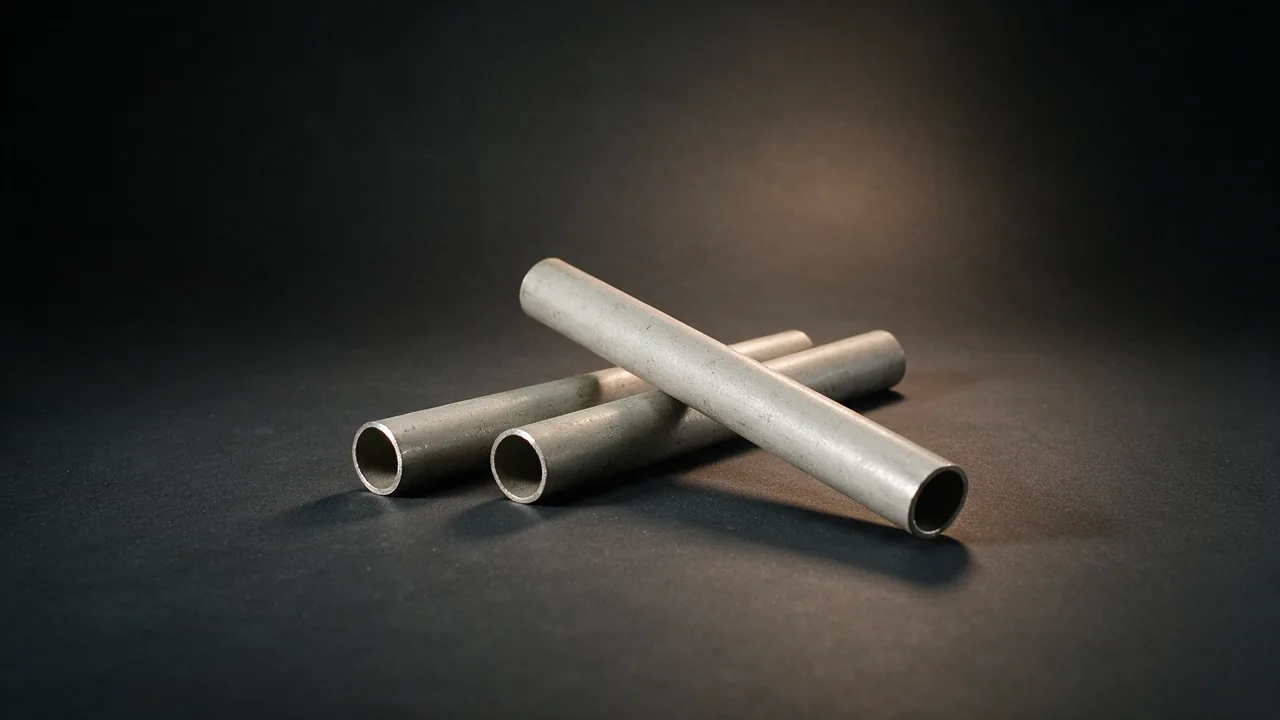
ASTM A312 TP304 is the general-purpose austenitic stainless steel pipe grade, with 18 to 20 percent chromium and 8 to 11 percent nickel, a minimum yield strength of 205 MPa and a minimum tensile strength of 515 MPa. It is the 304 composition written as a pipe grade: corrosion resistant in most service, tough at low temperature, and supplied in the annealed condition as seamless or welded pipe.
Download ASTM A312 TP304 Pipe data sheet (PDF) One-page summary of the supply range, chemistry, mechanical properties and inspection documents on this page. The standard is the governing document.
Mejor Steel is the export agent for the mills that make your material: one contract, one delivery date, and the mill named on the quotation. How we supply
We reply within one business day, Monday to Friday 09:00-18:00 CST. Or write to info@mejorsteel.com / WhatsApp.
Size range and specification
- Outside diameter 1/8 inch – 24 inch (10.3 – 610 mm)
- Wall thickness SCH 5S – SCH 80S, or by wall thickness
- Length SRL 5.8 m, DRL 11.8 m, or fixed length
- Ends Plain end, beveled end, threaded
- Surface treatment Pickled, annealed and pickled, bright annealed, polished
- Manufacturing process Seamless, welded, or heavily cold worked
- Heat treatment Solution annealed
- Delivery standard ASTM A312 / ASME SA312, dimensions to ASME B36.19M for the S schedules
- Delivery condition Annealed
How this grade is supplied
- Inspection Inspected by the producing mill’s own inspection department, which is independent of production, against the delivery standard above. Third-party inspection — SGS, BV or TUV, or an inspector you send yourself — can be arranged at the mill or before shipment; give us the dates and the scope at the order stage.
- Certificate A mill test certificate to EN 10204 3.1 showing the heat number, the chemical composition and the mechanical results is standard on every order. EN 10204 3.2, countersigned by the inspector you nominate, is available on request.
- Documents with the goods The mill test certificate and the packing list travel with the shipment, and the heat number is traceable from cast through to the finished product.
- Packing Sea-worthy export packing: bundled by size with end protection, corrosion protection on request, stencilled with the size, grade and heat number.
- MOQ One bundle or one truckload; mixed sizes within a bundle accepted.
- Lead time Counted from order confirmation, not from the enquiry. Stock sizes 5–10 days; mill run or non-stock 3–5 weeks. The delivery window is fixed on the quotation.
- How we supply Sourced through partner mills; the producing mill is named on the quotation.
ASTM A312 TP304 chemical composition (%)
| Element | Range | Element | Range |
|---|---|---|---|
| Carbon, C | 0.08 max | Nickel, Ni | 8.0 – 11.0 |
| Manganese, Mn | 2.00 max | Phosphorus, P | 0.045 max |
| Silicon, Si | 0.75 max | Sulphur, S | 0.030 max |
| Chromium, Cr | 18.0 – 20.0 | Molybdenum, Mo | not specified |
The chromium is what forms the passive oxide film that makes the steel stainless; the nickel holds the austenitic structure that gives it toughness and formability at low temperature. There is no deliberate molybdenum addition in TP304, which is the main difference between it and TP316 and the reason TP316 is preferred where chlorides are present. TP304L is the same composition with carbon capped at 0.035 percent, which reduces the risk of sensitization at weld joints but also lowers the minimum strength values.
Source: chemical composition requirements of ASTM A312 / ASME SA312. The standard is the governing document.
ASTM A312 TP304 mechanical properties
| Grade | Tensile strength | Yield strength | Elongation | Hardness |
|---|---|---|---|---|
| TP304 (ASTM A312) | 515 MPa min (75,000 psi) | 205 MPa min (30,000 psi) | 35% min | not specified for the grade |
| TP304L (for reference) | 485 MPa min (70,000 psi) | 170 MPa min (25,000 psi) | 35% min | not specified for the grade |
The two rows differ only because of carbon: the low-carbon L grade is annealed to a lower strength level in exchange for better weldability and resistance to sensitization. Yield strength for austenitic stainless steel is the 0.2 percent offset value, not the upper yield point that a carbon steel shows. The grade is not specified by hardness; where hardness matters the order states the requirement, and where sour service or a specific code applies, the code limit governs.
Source: tensile requirements of ASTM A312 / ASME SA312. The standard is the governing document.
What Is ASTM A312 TP304 Pipe?
ASTM A312 TP304 is austenitic stainless steel pipe made to the 304 composition – 18 to 20 percent chromium, 8 to 11 percent nickel – with a minimum yield strength of 205 MPa and a minimum tensile strength of 515 MPa. A312 covers seamless pipe, welded pipe and heavily cold worked pipe in the same specification, so the grade designation alone does not tell a buyer which of the three was supplied; that is stated separately on the order and on the certificate. The pipe is furnished annealed, which is the condition in which the 304 composition has its best combination of corrosion resistance and ductility.
Why Austenitic Stainless Is Chosen
The reason to specify TP304 rather than a coated or alloy carbon pipe is corrosion resistance with no coating to maintain. The chromium content forms a passive oxide layer that reforms if it is damaged, so the pipe resists atmospheric corrosion, most waters, and a wide range of organic and mildly aggressive chemicals. The austenitic structure also keeps the steel tough at low temperature, which is why stainless pipe is used cold where the carbon grades would need nickel additions. What TP304 does not tolerate well is chlorides: in chloride-bearing service pitting and stress corrosion cracking can occur, and that is when TP316 – the same steel with molybdenum added – or a duplex grade is selected instead.
TP304, TP304L and TP316 Compared
TP304 has up to 0.08 percent carbon and is the standard grade. TP304L caps carbon at 0.035 percent: the lower carbon reduces the tendency to form chromium carbides at the grain boundaries after welding, which is the sensitization that leaves a welded joint open to intergranular corrosion, and in exchange the specified minimum yield and tensile strengths are lower. TP316 keeps the same carbon and chromium level as TP304 but adds 2 to 3 percent molybdenum and raises nickel to 10 to 14 percent, which markedly improves resistance to pitting and crevice corrosion in chloride service. The usual progression on a project is TP304 for general service, TP304L where the pipe is welded and cannot be re-annealed, and TP316 or TP316L where chlorides or higher temperatures are present.
Where TP304 Pipe Is Used
TP304 pipe is used across process industries rather than in one application: chemical and petrochemical process lines, food, beverage and pharmaceutical piping where cleanability matters, potable and process water systems, heat exchanger and condenser tubing, pulp and paper lines, and general utility piping in plants that want to avoid painting or coating carbon steel. It is also used at low temperature, where its austenitic toughness is an advantage. In each of these cases the decision is normally between the 304 and 316 compositions rather than between stainless and carbon, and the deciding question is whether chlorides are present.
Sizes, Condition and Inspection
A312 TP304 pipe is supplied from about 1/8 inch to 24 inch outside diameter. Where a stainless schedule is specified, dimensions follow ASME B36.19M, whose S schedules are thinner than the matching ASME B36.10M carbon steel schedules. The pipe is furnished solution annealed and normally pickled or bright annealed, and welded pipe is supplied either as-welded or with the weld bead removed depending on the order. Documentation typically includes the mill certificate with the heat number and the chemistry and tensile results, and where the order calls for it, an intergranular corrosion test and a hydrostatic or eddy current test on welded pipe.
Surface condition — pickled, polished or bright annealed
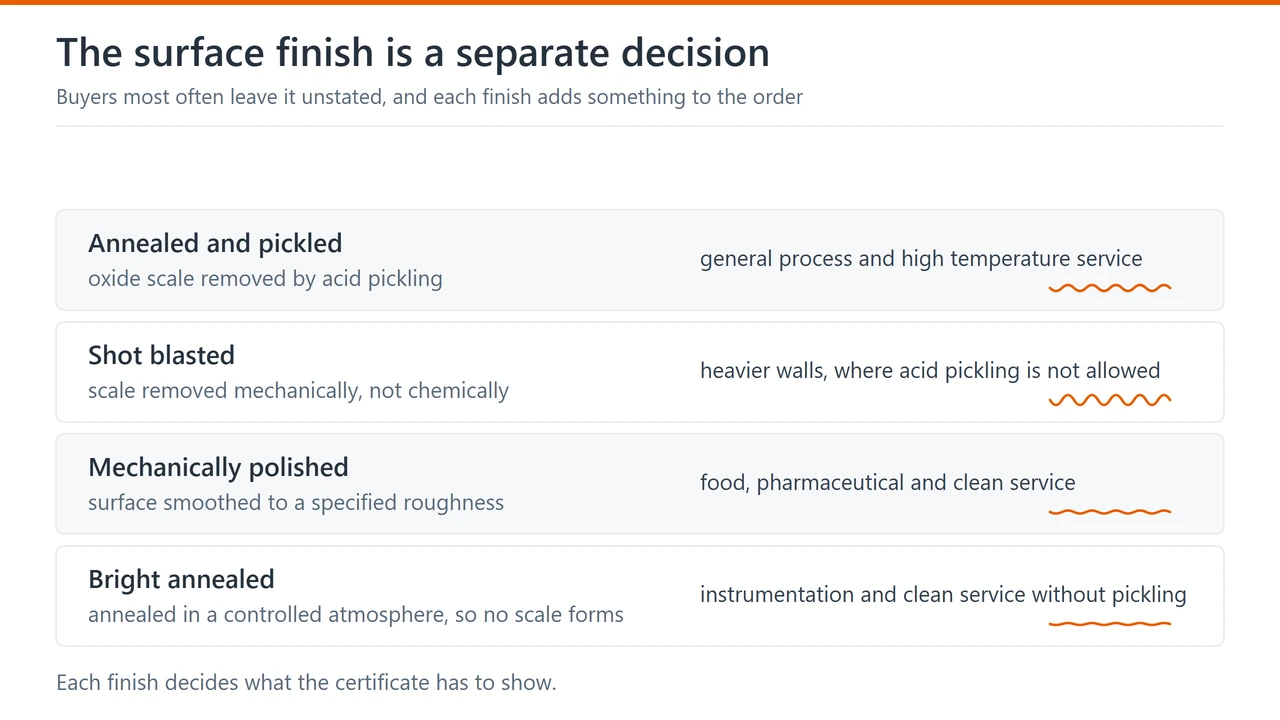
A312 requires the pipe to be furnished in the heat-treated condition (solution annealed for TP304). The surface finish is a separate decision, and it is the one buyers most often leave unstated.
| Finish | What it is | Typically specified for | What it adds to the order |
|---|---|---|---|
| Annealed and pickled | Oxide scale from annealing removed by acid pickling | General process and high-temperature service — the usual practical finish | Pickling and passivation records, and a defined surface condition |
| Shot blasted | Scale removed mechanically rather than chemically | Heavier walls and specifications that do not allow acid pickling | A different surface appearance and roughness |
| Mechanically polished | Surface smoothed to a specified roughness | Food, pharmaceutical and clean service where hygiene or appearance matters | A roughness requirement that has to be written numerically |
| Bright annealed | Annealed in a controlled atmosphere so no scale forms | Instrumentation and clean service where pickling is not wanted | Atmosphere-annealed condition and stricter handling in packing |
Source: ASTM A312 heat-treatment and finish requirements, cross-checked against published mill catalogues. If the project has a roughness or finish callout, state it numerically; “polished” on its own is not a specification.
Which test are you actually buying
Every length of A312 pipe is tested, and the standard provides more than one route: a hydrostatic pressure test, or a nondestructive electric test such as eddy current or ultrasonic testing. The two do not look for the same thing.
| Route | What it proves | Where it leaves a gap |
|---|---|---|
| Hydrostatic test | The pipe contains pressure at the test pressure without leaking or deforming | It is a proof test; it does not size or locate a discontinuity |
| Eddy current or ultrasonic test | Discontinuities in the body or the weld are detected and located | It is a detection test; it does not prove pressure containment |
Because both routes exist inside the same standard, the purchase order has to name the one the project requires. If it does not, the mill may supply whichever route its line is set up for, and the certificate will state only the test that was actually performed. Two fields close that gap: the test name with its extent, and whether a third party has to witness it.
A312, A213 and A269 are not interchangeable
The same TP304 heat can be made into pipe or tube to any of three specifications, and the certificate then describes a different product. That difference is what decides acceptance at the site.
| Specification | Product | Typical service |
|---|---|---|
| ASTM A312 | Austenitic stainless steel pipe — seamless, straight-seam welded, and heavily cold worked welded | High-temperature and general corrosive service; sizes from small bore up to about 30 in |
| ASTM A213 | Seamless ferritic and austenitic alloy steel tube | Boiler, superheater and heat exchanger tubes — tube, not pipe |
| ASTM A269 | Seamless and welded austenitic stainless steel tubing | General service and instrumentation tubing |
If the project calls for A312 pipe and the quotation is for A269 tube, or an A213 heat exchanger tube is offered against an A312 pipe requirement, the material will be rejected at goods-in even though the chemistry looks identical. Ask for the specification number in writing before the order is placed.
What to state on the enquiry
- Grade: TP304, TP304L, TP316 or TP316L, and whether dual certification is acceptable.
- Manufacturing method: seamless or welded.
- Outside diameter, wall thickness or schedule, and length.
- Finish: annealed and pickled, shot blasted, polished to a stated roughness, or bright annealed.
- Test route: hydrostatic, or eddy current or ultrasonic testing, with the extent required.
- Third-party witnessing, if the project requires it.
- Certificate: EN 10204 3.1, or 3.2 with third-party countersignature; and dual-standard certification if the pipe also has to meet a European specification.
- Quantity, destination port and Incoterms.
Typical applications
- Chemical and petrochemical process piping
- Food, beverage and pharmaceutical piping
- Process and potable water systems
- Heat exchanger and condenser tubing
- Low-temperature piping where austenitic toughness is wanted
Standards covered
Frequently asked questions
What is the difference between TP304 and TP304L?
The letter L stands for low carbon. TP304 allows up to 0.08 percent carbon and TP304L caps it at 0.035 percent. The lower carbon limits the formation of chromium carbides at the grain boundaries after welding, which is what makes a welded joint vulnerable to intergranular corrosion, so TP304L is used where the pipe is welded and cannot be solution annealed afterwards. The trade-off is strength: TP304L is specified at 485 MPa minimum tensile and 170 MPa minimum yield against 515 and 205 for TP304.
When should TP316 be used instead of TP304?
When chlorides are present, or when the service temperature is high enough for stress corrosion cracking to be a risk. TP316 contains 2 to 3 percent molybdenum, which raises resistance to pitting and crevice corrosion in chloride-bearing water and process streams, while TP304 contains no deliberate molybdenum. Where the environment is simply water, air or a mildly corrosive chemical, TP304 is normally adequate and cheaper.
What does ASTM A312 cover?
A312 is the specification for seamless, welded and heavily cold worked austenitic stainless steel pipe. All three routes are covered by the one specification, so the grade name alone – TP304 – does not say how the pipe was made. The manufacturing route appears on the order and on the mill certificate, and welded pipe carries the additional weld inspection the order specifies.
Where to go next
- Stainless Steel Pipe – grades, standards and how the order is fixed
- ASTM A312 Stainless Steel Pipe – seamless and welded austenitic stainless pipe
- ASTM A312 TP316 Pipe – the molybdenum-bearing grade for chloride service
- Stainless Steel Butt Weld Fittings – stainless butt weld fittings to ASME B16.9
- Boiler & Heat Exchanger Tube – tube specified by outside diameter and wall
- Pipe Schedule Chart – wall thickness for every schedule
- Steel Pipe Standards & Grades – every grade page in this section
- Get a Quote – send the grade, size, quantity and destination port
- ASTM A269 Tubing – the stainless tubing specification for instrumentation and hygienic service
Ready to price your enquiry? Tell us the specification, the dimensions, how much you need and where it is going. We reply with what is available and what it costs.
Request a quotation