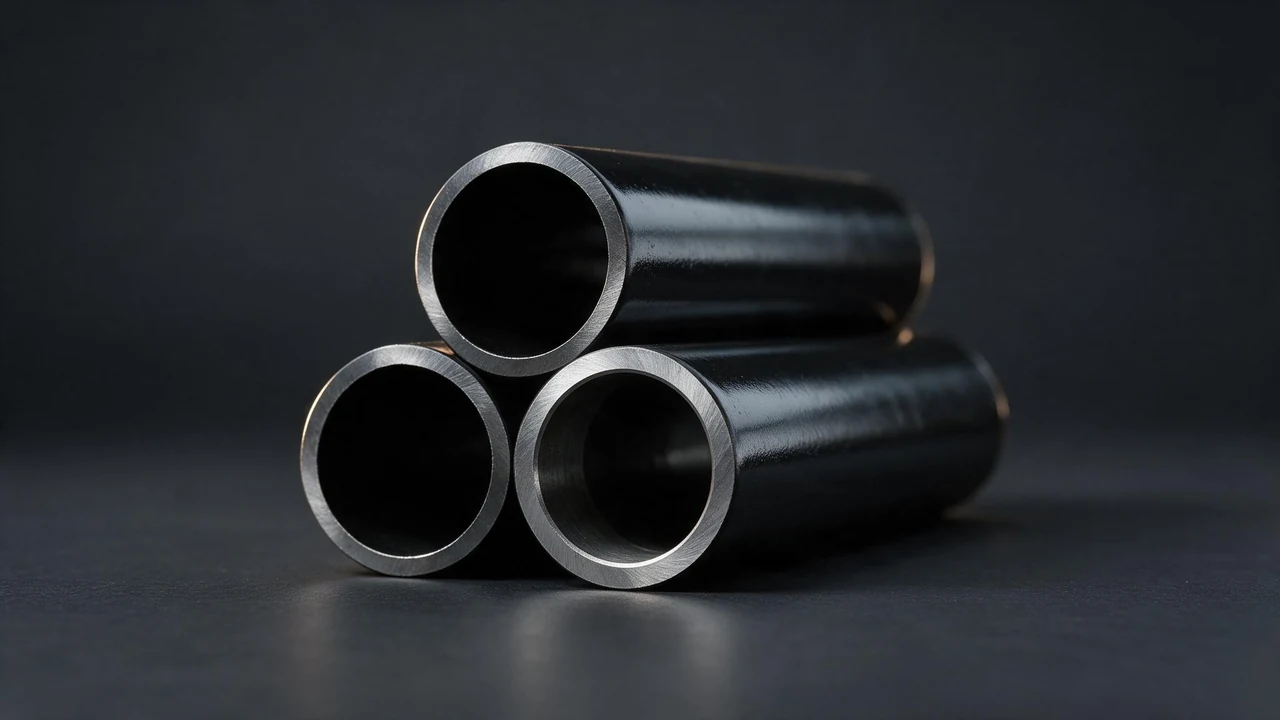
ASTM A106 Grade C is the highest-carbon and highest-strength of the three A106 grades, with a maximum carbon of 0.35 percent, a minimum yield strength of 275 MPa (40,000 psi) and a minimum tensile strength of 485 MPa (70,000 psi). It is a seamless-only carbon steel grade for high-temperature service, chosen where Grade B is not strong enough at an economical wall.
Download ASTM A106 Grade C Pipe data sheet (PDF) One-page summary of the supply range, chemistry, mechanical properties and inspection documents on this page. The standard is the governing document.
Mejor Steel is the export agent for the mills that make your material: one contract, one delivery date, and the mill named on the quotation. How we supply
We reply within one business day, Monday to Friday 09:00-18:00 CST. Or write to info@mejorsteel.com / WhatsApp.
Size range and specification
- Outside diameter 1/2 inch – 24 inch (12.7 – 610 mm); seamless only
- Wall thickness SCH 40 – SCH 160 and heavier; typically 3.91 – 40 mm
- Length SRL 5.8 m, DRL 11.8 m, 20 FT, 40 FT, or random 4 – 12 m
- Ends Plain end, beveled end, threaded with coupling
- Surface treatment Black varnish, bare, rust preventive oil, hot dip galvanized on request
- Manufacturing process Seamless only – welded pipe is not permitted by A106
- Heat treatment No heat treatment required as supplied; normalizing available on request
- Delivery standard ASTM A106 / ASME SA106, dimensions to ASME B36.10M
- Delivery condition As-rolled; normalized on request
How this grade is supplied
- Inspection Inspected by the producing mill’s own inspection department, which is independent of production, against the delivery standard above. Third-party inspection — SGS, BV or TUV, or an inspector you send yourself — can be arranged at the mill or before shipment; give us the dates and the scope at the order stage.
- Certificate A mill test certificate to EN 10204 3.1 showing the heat number, the chemical composition and the mechanical results is standard on every order. EN 10204 3.2, countersigned by the inspector you nominate, is available on request.
- Documents with the goods The mill test certificate and the packing list travel with the shipment, and the heat number is traceable from cast through to the finished product.
- Packing Sea-worthy export packing: bundled by size with end protection, corrosion protection on request, stencilled with the size, grade and heat number.
- MOQ One bundle or one truckload; mixed sizes within a bundle accepted.
- Lead time Counted from order confirmation, not from the enquiry. Stock sizes 5–10 days; mill run or non-stock 3–5 weeks. The delivery window is fixed on the quotation.
- How we supply Sourced through partner mills; the producing mill is named on the quotation.
ASTM A106 Grades A, B and C chemical composition (maximum unless a range is given, %)
| Element | Grade A | Grade B | Grade C |
|---|---|---|---|
| Carbon, C | 0.25 max | 0.30 max | 0.35 max |
| Manganese, Mn | 0.27 – 0.93 | 0.29 – 1.06 | 0.29 – 1.06 |
| Phosphorus, P | 0.035 max | 0.035 max | 0.035 max |
| Sulphur, S | 0.035 max | 0.035 max | 0.035 max |
| Silicon, Si | 0.10 min | 0.10 min | 0.10 min |
Carbon and manganese are the only two elements A106 varies between grades; phosphorus, sulphur and silicon carry the same limit in all three. The manganese maxima above are those printed in the standard, and the standard also allows manganese to be raised above its maximum when carbon is supplied below its maximum – the permitted increase is stated as a fixed step for each 0.01% of carbon given up, so a mill certificate showing manganese over 1.06% for Grade C is not automatically a non-conformance. Read the two figures together. Chromium, copper, molybdenum and nickel are residual elements and the separate limits that apply to them are set out in the table below, not in this one.
Source: chemical composition requirements of ASTM A106 / ASME SA106, Table 1. The standard is the governing document.
ASTM A106 tensile requirements – Grades A, B and C
| Grade | Tensile strength min | Yield strength min | Elongation min, longitudinal | Maximum hardness |
|---|---|---|---|---|
| Grade A (for reference) | 330 MPa (48,000 psi) | 205 MPa (30,000 psi) | 35% | not specified |
| Grade B (for reference) | 415 MPa (60,000 psi) | 240 MPa (35,000 psi) | 30% | not specified |
| Grade C | 485 MPa (70,000 psi) | 275 MPa (40,000 psi) | 30% | not specified |
The elongation column is the basic minimum that applies to longitudinal strip tests and to all small sizes tested in full section, which is how most A106 pipe is actually tested. It steps with the specimen and the test direction, and buying to a single number without saying which one is the commonest source of dispute on this grade: tested on a standard round 2 in. gauge-length specimen the minima fall to 28% for Grade A, 22% for Grade B and 20% for Grade C; a transverse strip test gives 25%, 16.5% and 16.5%. For transverse strip tests a deduction is also taken for every 1/32 in. of wall below 5/16 in., at 1.25% for Grade A and 1.00% for Grades B and C. If elongation is a design constraint, put the specimen type and the test direction on the order. Hardness is not specified by A106 for any of the three grades.
Source: tensile requirements of ASTM A106 / ASME SA106, Table 1. The standard is the governing document.
Residual element limits that apply to all three A106 grades (%)
| Element | Limit |
|---|---|
| Chromium, Cr | 0.40 max |
| Molybdenum, Mo | 0.15 max |
| Nickel, Ni | 0.40 max |
| Copper, Cu | 0.40 max |
| Vanadium, V | 0.08 max |
These five limits sit in the same table as the grade chemistry and apply to Grades A, B and C alike; they control residuals rather than deliberate alloying, and they are what keep the steel a plain carbon steel. They matter most for Grade C, because a heat of Grade C already works at the top of the carbon and manganese ranges and has the least room left before the steel becomes difficult to weld. For illustration only, a heat at the tabulated maxima of 0.35 percent carbon and 1.19 percent manganese would sit at a C + Mn/6 of about 0.55, against about 0.48 for Grade B at its maxima; a mill does not aim at both maxima at once, and the number that governs welding is the one reported on the certificate for the heat actually supplied.
What Is ASTM A106 Grade C Pipe?
ASTM A106 Grade C is one of the three grades in ASTM A106, the specification for seamless carbon steel pipe for high-temperature service. It is defined by a maximum carbon content of 0.35 percent, a minimum yield strength of 275 MPa (40,000 psi) and a minimum tensile strength of 485 MPa (70,000 psi). A106 is written for pipe that carries steam, hot process fluids and similar media, so it requires a minimum silicon content, holds phosphorus and sulphur to 0.035 percent each, and permits seamless construction only. Grade C is the top of the three grades in strength terms and also the one with the highest carbon and manganese: more strength per millimetre of wall, and less tolerance in welding, is the trade-off it carries.
How Grade C Differs from A106 Grades A and B
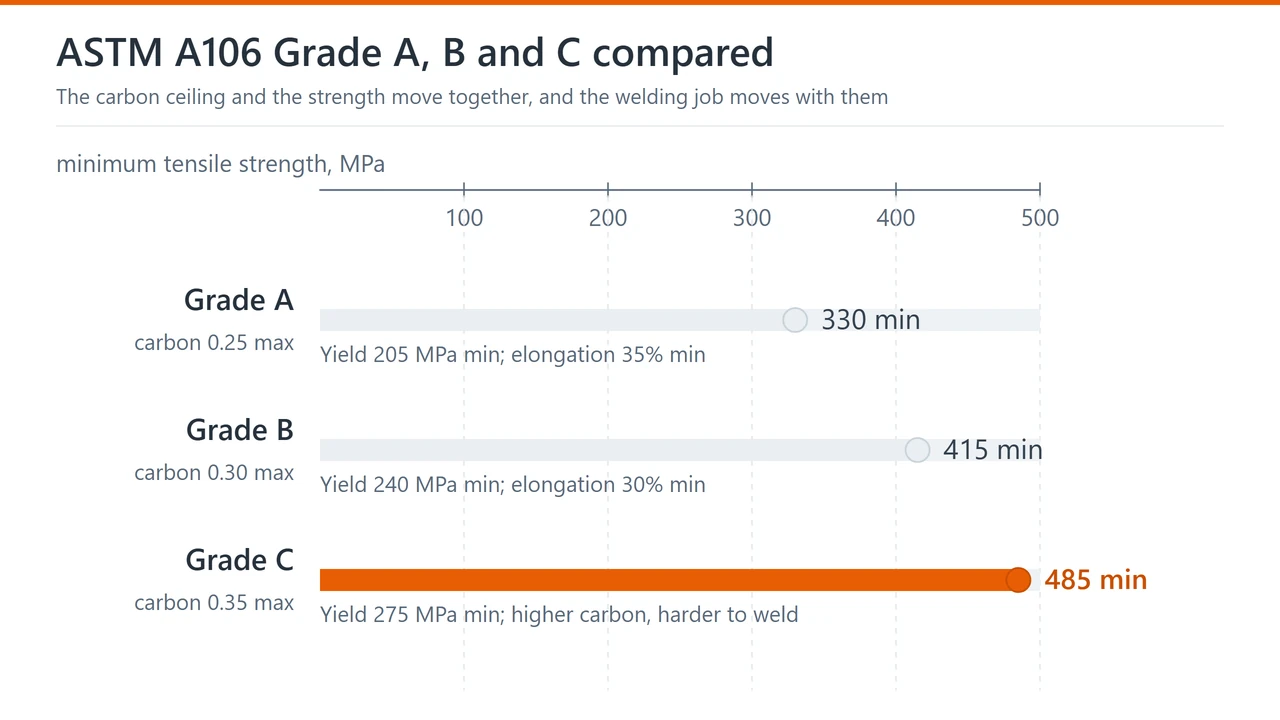
The three A106 grades are separated by two lines of the chemistry table. Grade A allows 0.25 percent carbon with manganese from 0.27 to 0.93 percent, Grade B allows 0.30 percent carbon with manganese from 0.29 to 1.06 percent, and Grade C allows 0.35 percent carbon with manganese from 0.29 to 1.19 percent. Phosphorus, sulphur, the 0.10 percent minimum silicon and the residual limits are the same for all three. Strength therefore follows the carbon and manganese: minimum yield strength steps from 205 to 240 to 275 MPa, and minimum tensile strength from 330 to 415 to 485 MPa. The grades are dimensionally and metallurgically interchangeable, so the choice between them is a design stress decision made from the pressure, the temperature and the wall thickness.
The three grades are compared below on carbon ceiling and minimum tensile strength.
Where A106 Grade C Pipe Is Used, and Where It Is Not
Grade C is chosen when a carbon steel line at high temperature needs more strength than Grade B can give at an economical wall thickness, typically on steam and hot process lines in the upper part of the carbon steel temperature range, where the designer wants to hold the wall down rather than step up to a chrome-molybdenum grade. It is not a general-purpose pipe. Grade C is a poor answer where the pipe will be welded in difficult field conditions, because at 0.35 percent carbon it has the least weldability of the three grades. Nor is it the right answer at low temperature: A106 carries no impact test requirement at all, and the highest-carbon grade has the least toughness when cold, so cold service belongs to ASTM A333. Where the temperature exceeds what carbon steel can hold, the answer is an alloy grade such as A335 P11 or P22, not a higher-carbon carbon steel.
Carbon, Manganese and the Carbon Equivalent
The reason Grade C is stronger is also the reason it is harder to weld. Carbon and manganese both raise the strength of ferrite-pearlite steel, and both also raise the carbon equivalent, the number that best predicts how readily a weld and its heat-affected zone will harden and crack. Taking the tabulated maxima, a Grade C heat sits at a C + Mn/6 of about 0.55 against about 0.48 for Grade B, and these are arithmetic on the table rather than a requirement of the standard. In practice a mill does not aim at both maxima at once, and the figures for the heat actually supplied are reported on the mill certificate. What matters at the enquiry stage is that a Grade C line is normally welded with preheat, a qualified procedure and, on heavier walls, post-weld heat treatment – a fabrication cost the design should carry from the start.
Sizes, Delivery Condition and Testing
A106 Grade C is supplied as seamless pipe from 1/2 inch to about 24 inch nominal outside diameter with dimensions to ASME B36.10M, so a line can be ordered in the usual trade designations – NPS 6 SCH 40, NPS 8 SCH 80 or NPS 12 SCH 160, for example. It is normally delivered as-rolled without heat treatment, and normalizing can be ordered where a uniform ferrite-pearlite structure is wanted or where the pipe will be hot formed. Each length is hydrostatically tested, and a non-destructive electric test may replace or supplement the hydrostatic test where the order permits. Tensile, yield and elongation results are reported for each heat together with the chemistry. Where the line is to run in sour service, the additional NACE MR0175 / ISO 15156 requirements belong on the purchase order, because A106 itself says nothing about them.
What the higher carbon content does to the welding job
Grade C allows more carbon than Grade A or Grade B, which is exactly why it reaches a higher tensile strength — and exactly why the fabrication procedure has to be checked before the spool is welded.
A106 requires the steel to conform to a carbon equivalent (CE) of 0.50% maximum. The value is calculated from the heat analysis on the mill test certificate:
CE = C + Mn/6 + (Cr + Mo + V)/5 + (Ni + Cu)/15
Two consequences for the order:
- A Grade C heat can sit at a carbon equivalent that requires preheat where a Grade B heat for the same line would not. The welding procedure has to cover the actual heat, not the nominal grade.
- The check belongs at the material-receipt stage: read the heat analysis on the mill test certificate and confirm the calculated equivalent is inside the range the welding procedure was qualified for. If it is outside, the choice is a revised procedure or a different heat — not a hope that the welder will manage.
Source: ASTM A106 chemical requirements for Grades A, B and C, and the carbon equivalent formula in common use for carbon steel piping. Confirm the applicable limits in the project welding specification.
Hardness and heat treatment — what A106 does not fix
A106 sets chemistry, tensile requirements, and the bending and flattening tests. It does not set a hardness limit. Where a line specification calls for a hardness cap — for example in wet H2S service or where hardness is used as a proxy for toughness — that requirement has to be written on the order, and the test has to be arranged.
The same applies to heat treatment. If the project requires a specific condition or a heat-treatment record beyond the standard requirement, it belongs in the purchase order and in the certificate, not in a note after the pipe has been made.
Availability — why Grade C behaves like a mill-run grade
Grade C is ordered far less often than Grade B, so it is normally rolled to order rather than held in stock. Three practical consequences:
- The economical order quantity is usually a mill-run quantity rather than a few joints, so the enquiry should carry the realistic tonnage rather than a trial figure.
- The size list matters: a mixed size list in one heat is easier to make than the same tonnage in one unusual size.
- Lead time should be taken from the mill programme for that specific size and grade, not from a general figure used for Grade B.
We quote Grade C against the current mill programme for the size and quantity in the enquiry; stock availability and lead time are confirmed with the quotation rather than quoted as a standing figure.
What to state on the enquiry
- Grade: A106 Grade C, with any supplementary requirement.
- Outside diameter, wall thickness or schedule, and length.
- Quantity in tonnes, and whether partial supply or a mixed size list is acceptable.
- End finish, and any surface or coating requirement.
- Any hardness limit, heat-treatment record, or additional test required by the line specification.
- Certificate: EN 10204 3.1, or 3.2 with third-party countersignature.
- Destination port and Incoterms.
Typical applications
- High-temperature steam and hot process piping above the Grade B strength level
- Boiler and superheater connection piping where a thinner carbon steel wall is wanted
- High-temperature process piping in refineries and chemical plants
- Compressed hot gas and vapour lines
- Replacement pipe matching an existing Grade C specification
Standards covered
Frequently asked questions
What is the difference between ASTM A106 Grade B and Grade C?
Chemistry, and therefore strength. Grade C raises the carbon maximum from 0.30 to 0.35 percent and widens the manganese range from 0.29 – 1.06 to 0.29 – 1.19 percent, which lifts the minimum yield strength from 240 to 275 MPa and the minimum tensile strength from 415 to 485 MPa. Phosphorus, sulphur, silicon and the residual limits are the same. The extra strength is paid for in weldability: Grade C needs more preheat and tighter procedure control than Grade B.
Can A106 Grade C be used at low temperature?
Not on the basis of A106 alone. A106 specifies no impact test requirement, and Grade C is the highest-carbon of the three grades, so it has the least low-temperature toughness of the three. Where the design temperature is low, the correct specification is ASTM A333 – Grade 6 down to about minus 45 degrees Celsius, and a nickel-bearing grade such as Grade 3 below that.
Why is A106 Grade C ordered less often than Grade B?
Because Grade B covers most carbon steel high-temperature duty. Moving to Grade C buys about 15 percent more yield strength, which only matters where the extra pressure rating or the thinner wall is actually needed; where it is not, Grade B is cheaper, more widely available from stock and easier to weld. Grade C is normally a project-specific order rather than a stock item, which also affects how quickly it can be found in a given size.
Does A106 Grade C need heat treatment?
It is normally supplied as-rolled without heat treatment, and that is an acceptable delivery condition under A106. Normalizing is available on request where a uniform ferrite-pearlite structure is wanted, for example where the pipe will be hot formed. Any post-weld heat treatment comes from the construction code that governs the line, such as ASME B31.1, rather than from A106 itself, and it should be specified on the purchase order.
Where to go next
- ASTM A106 Grade B Pipe – the high-temperature seamless grade most often quoted
- ASTM A335 P11 Alloy Steel Pipe
- ASTM A333 Grade 6 Pipe – the low temperature carbon pipe grade
- Boiler & Heat Exchanger – tube and pipe for boilers and heat exchangers
- Pipe Schedule Chart – wall thickness for every schedule
- Get a Quote – send the grade, size, quantity and destination port
- ASTM A106 Seamless Carbon Steel Pipe – seamless pipe for process and boiler service
- Boiler & Heat Exchanger Tube – tube specified by outside diameter and wall
- ASTM A335 Alloy Steel Pipe – alloy steel pipe for high-temperature service
- A106 Grade B vs Grade C – what the higher carbon ceiling changes in fabrication
Four details and we can quote. The grade or the standard the material has to meet, the size and wall thickness, the tonnage, and the destination port. Send them together and we answer with availability and pricing.
Request a quotation