ASTM A335 P11 – also written ASME SA335 Grade P11, UNS K11597 – is a 1.25 percent chromium, 0.5 percent molybdenum alloy steel pipe for high-temperature service. Normalized and tempered, it has a minimum yield strength of 205 MPa and a minimum tensile strength of 415 MPa, and it is the lowest step of the chrome-molybdenum ladder used for steam and process piping, sitting below P22 and P91.
Download ASTM A335 P11 Alloy Steel Pipe data sheet (PDF) One-page summary of the supply range, chemistry, mechanical properties and inspection documents on this page. The standard is the governing document.
Mejor Steel is the export agent for the mills that make your material: one contract, one delivery date, and the mill named on the quotation. How we supply
We reply within one business day, Monday to Friday 09:00-18:00 CST. Or write to info@mejorsteel.com / WhatsApp.
Size range and specification
- Outside diameter 1/2 inch – 36 inch (12.7 – 914 mm)
- Wall thickness SCH 40 – SCH XXS, or by wall thickness
- Length SRL 5.8 m, DRL 11.8 m, or fixed length
- Ends Plain end, beveled end
- Surface treatment Black varnish, bare, rust preventive oil
- Manufacturing process Hot finished seamless
- Heat treatment Normalized and tempered
- Delivery standard ASTM A335 / ASME SA335, dimensions to ASME B36.10M
- Delivery condition Normalized and tempered
How this grade is supplied
- Inspection Inspected by the producing mill’s own inspection department, which is independent of production, against the delivery standard above. Third-party inspection — SGS, BV or TUV, or an inspector you send yourself — can be arranged at the mill or before shipment; give us the dates and the scope at the order stage.
- Certificate A mill test certificate to EN 10204 3.1 showing the heat number, the chemical composition and the mechanical results is standard on every order. EN 10204 3.2, countersigned by the inspector you nominate, is available on request.
- Documents with the goods The mill test certificate and the packing list travel with the shipment, and the heat number is traceable from cast through to the finished product.
- Packing Sea-worthy export packing: bundled by size with end protection, corrosion protection on request, stencilled with the size, grade and heat number.
- MOQ One bundle or one truckload; mixed sizes within a bundle accepted.
- Lead time Counted from order confirmation, not from the enquiry. Stock sizes 5–10 days; mill run or non-stock 3–5 weeks. The delivery window is fixed on the quotation.
- How we supply Sourced through partner mills; the producing mill is named on the quotation.
ASTM A335 P11 chemical composition (%)
| Element | Range | Element | Range |
|---|---|---|---|
| Carbon, C | 0.05 – 0.15 | Nickel, Ni | 0.50 max |
| Manganese, Mn | 0.30 – 0.60 | Chromium, Cr | 1.00 – 1.50 |
| Phosphorus, P | 0.025 max | Molybdenum, Mo | 0.44 – 0.65 |
| Sulphur, S | 0.025 max | ||
| Silicon, Si | 0.50 – 1.00 |
The chromium and molybdenum ranges are what give P11 its elevated-temperature strength and its resistance to oxidation and to steam attack; 1.25 percent chromium is the lowest level at which a chrome-molybdenum pipe grade is normally specified. The carbon range is deliberately low so that the steel stays weldable and tough, and phosphorus and sulphur are held to 0.025 percent each because both reduce creep ductility. Silicon is specified at 0.50 to 1.00 percent, higher than in the carbon steel pipe grades, which contributes to oxidation resistance at temperature. The nickel figure is a residual control rather than an alloy addition. Some published tables give slightly different silicon or residual limits, so the mill certificate should be read against the edition of A335 the order names.
Source: chemical composition requirements of ASTM A335 / ASME SA335, Table 1. The standard is the governing document.
ASTM A335 P11 mechanical properties (normalized and tempered)
| Grade | Tensile strength | Yield strength | Elongation | Test basis |
|---|---|---|---|---|
| P11 (ASTM A335) | 415 MPa min (60,000 psi) | 205 MPa min (30,000 psi) | 30% min | Room temperature, longitudinal |
These are the room-temperature requirements of ASTM A335 for Grade P11 in the normalized and tempered condition, and they are the same as those of P22 – a reminder that the room-temperature strength is not what separates the chrome-molybdenum grades. The stresses used to size a hot line are the elevated-temperature allowable stresses tabulated in ASME B31.1 and in the ASME Boiler and Pressure Vessel Code, and they fall as the temperature rises. Where a hardness limit is required for a particular duty – for example for sour service, where NACE MR0175 / ISO 15156 caps carbon and low-alloy steels at 22 HRC (250 HV) – it belongs on the purchase order and the certificate should be read against it.
Source: tensile requirements of ASTM A335 / ASME SA335, Table 1. The standard is the governing document.
Heat treatment of ASTM A335 P11
| Item | Requirement | What it does |
|---|---|---|
| Normalizing | 1650 degrees F (900 degrees C) minimum, air cooled | Refines the grain structure and produces a uniform ferrite-pearlite or bainitic structure |
| Tempering | 1150 degrees F (620 degrees C) minimum | Relieves the stresses left by normalizing and sets the balance of strength, hardness and toughness |
| Delivery condition | Normalized and tempered | The condition in which the room-temperature properties above apply |
| Recording | Recorded on the mill certificate | The tempering temperature is the control that governs how the steel behaves in long service |
A335 specifies minimum temperatures for the normalizing and tempering of the ferritic chrome-molybdenum grades, so a mill is free to work hotter than the table but not colder. The minimum matters because normalizing below the lower critical temperature leaves parts of the structure untransformed, and under-tempering leaves the steel too hard and too brittle for a pressure part. The actual temperatures used for the heat supplied appear on the mill certificate together with the tensile and yield results, and they should be read as a set: the same grade tempered at two different temperatures can show noticeably different hardness and toughness.
The chrome-molybdenum ladder: P11, P22 and P91 at room temperature
| Grade | UNS | Nominal composition | Tensile strength min | Yield strength min |
|---|---|---|---|---|
| P11 | K11597 | 1.25Cr – 0.5Mo | 415 MPa (60,000 psi) | 205 MPa (30,000 psi) |
| P22 | K21590 | 2.25Cr – 1Mo | 415 MPa (60,000 psi) | 205 MPa (30,000 psi) |
| P91 | K91560 | 9Cr – 1Mo – V | 585 MPa (85,000 psi) | 415 MPa (60,000 psi) |
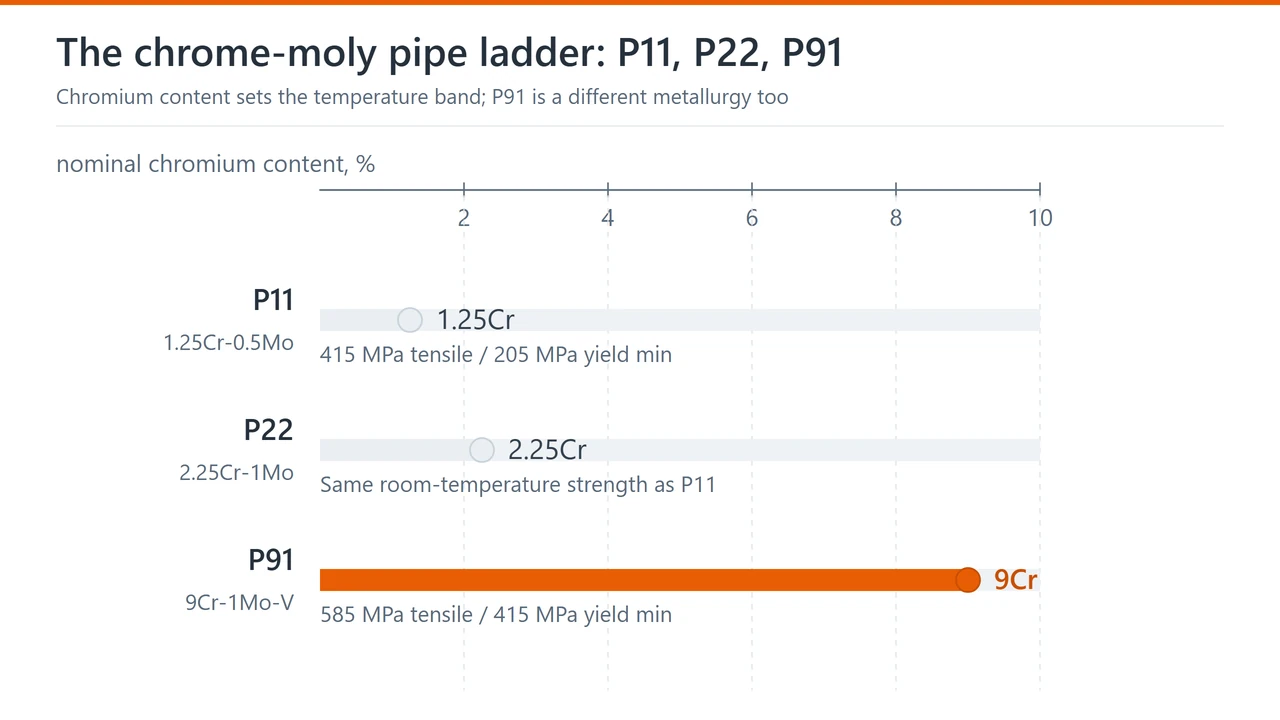
P11 and P22 carry identical room-temperature minimum strengths, and P91 is the only one of the three that is stronger at room temperature. The reason to move up the ladder is therefore not the table above but the elevated-temperature allowable stress: as the chromium and molybdenum content rises, the grade holds more stress at a given temperature, so a thinner wall will carry the same pressure. That is what decides between P11, P22 and P91 in a piping class, and it is why the choice is made by the designer from the operating temperature and pressure rather than by the purchaser from the specification sheet.
What Is ASTM A335 P11 Pipe?
ASTM A335 P11 – ASME SA335 Grade P11, UNS K11597 – is a seamless alloy steel pipe for high-temperature service with 1.00 to 1.50 percent chromium and 0.44 to 0.65 percent molybdenum, usually written 1.25Cr-0.5Mo. In the normalized and tempered condition it has a minimum yield strength of 205 MPa (30,000 psi) and a minimum tensile strength of 415 MPa (60,000 psi) – the same room-temperature strength as a plain carbon steel boiler pipe, which is exactly the point. P11 is not bought for room-temperature strength; it is bought for the strength it keeps at temperature, where the chromium holds off oxidation and steam attack and the molybdenum raises the temperature at which the steel starts to creep.
Where P11 Sits: Below P22 and P91
P11 is the bottom step of the chrome-molybdenum ladder, P22 the middle and P91 the top. P22 carries 1.90 to 2.60 percent chromium and 0.87 to 1.13 percent molybdenum; P91 carries 8.00 to 9.50 percent chromium with vanadium and niobium additions and is roughly 40 percent stronger at room temperature as well. All three follow the same ferritic chrome-molybdenum idea, but the allowable stress each one holds at temperature rises steeply with alloy content: at 540 degrees Celsius the step from P11 to P22 is already worth a thinner wall, and the step from P22 to P91 is worth much more again. The choice is a design decision made from the operating temperature, the pressure and the allowable stress tables of the applicable code. P11 is specified where the temperature is at the low end of the three and the extra chromium of P22 buys nothing the design actually needs.
The three grades and the chromium content behind them are shown below.
The Upper Temperature Limit for P11, and Why It Exists
A335 itself sets no maximum service temperature. The limit for P11 comes from the allowable stress the design code tabulates for the grade at the design temperature, and published guidance commonly places the practical ceiling for 1.25Cr-0.5Mo in the 540 to 590 degrees Celsius band. Two mechanisms set it. The first is creep: above roughly 430 to 480 degrees Celsius a low-alloy steel begins to deform slowly under sustained load, and the allowable stress falls as the temperature rises, so the wall needed to hold a given pressure grows until it stops being economic. The second is oxidation: 1.25 percent chromium forms a protective oxide, but a thinner and less protective one than 2.25 percent chromium does, so scaling and steam-side attack become limiting at a lower temperature. Above that band a designer moves to P22, and above P22 to P91 – not because P11 fails, but because the wall it would need is no longer practical.
Normalizing and Tempering: Why the Heat Treatment Is Specified
P11 is supplied normalized and tempered, and the heat treatment is part of the specification rather than a mill preference. Normalizing – heating to at least 1650 degrees Fahrenheit (900 degrees Celsius) and cooling in air – refines the grain structure and produces a uniform ferrite-pearlite or bainitic structure. Tempering at a minimum of 1150 degrees Fahrenheit (620 degrees Celsius) then relieves the stresses left by that structure and sets the balance of strength, hardness and toughness. The tempering temperature is the control that matters most in service, because it decides how the steel behaves after years at temperature, and it is recorded on the mill certificate with the mechanical results. Where the pipe is welded, the fabrication heat treatment follows the same logic and is controlled to it.
Sizes, Welding and Documentation
P11 is supplied as hot finished seamless pipe in the usual sizes and schedules, from 1/2 inch up to about 36 inch outside diameter with dimensions to ASME B36.10M. Typical trade descriptions are NPS 6 SCH 80, NPS 10 SCH 40 or NPS 16 SCH 60, and a specific wall thickness can be ordered where the piping class calls for it. Ends are plain or beveled. Because P11 is a creep-grade steel, the mill certificate carries the chemistry, the tensile and yield results and the heat treatment record, and the pipe is normally ordered with the heat number traceable. Welding is routine but not the same as welding carbon steel: preheat and interpass temperature are controlled, the filler metal must match the chrome-molybdenum composition, and post-weld heat treatment is usual on heavier walls. Fittings and flanges in the matching WP11 and F11 grades are used on the same line so that pipe, fitting and flange share one allowable stress basis.
Typical applications
- Steam and condensate piping in power plants at moderate superheat
- Refinery and petrochemical process piping at elevated temperature
- Boiler and heat recovery steam generator piping
- High-temperature heat exchanger and furnace piping
- Steam headers and distribution lines where carbon steel has run out of allowable stress
Standards covered
What to state on the enquiry
- ASTM A335 P11, supplied normalized and tempered.
- Size and schedule, or outside diameter and wall.
- Quantity and destination port.
- Certificate type and any inspection requirements.
Frequently asked questions
What is the difference between P11 and P22?
Alloy content, and therefore the allowable stress at temperature. P11 carries 1.00 – 1.50 percent chromium and 0.44 – 0.65 percent molybdenum; P22 carries 1.90 – 2.60 percent chromium and 0.87 – 1.13 percent molybdenum. Their room-temperature minimum strengths are the same, 415 MPa tensile and 205 MPa yield, so the difference only appears when the pipe is hot: P22 holds a higher allowable stress and can therefore run at a higher temperature, or at the same temperature with a thinner wall. P11 is the cheaper of the two and is used where the design temperature does not call for P22.
What is the maximum service temperature for A335 P11 pipe?
A335 does not fix one. The limit is set by the allowable stress the design code tabulates for 1.25Cr-0.5Mo at the design temperature – normally ASME B31.1 for power piping, or the ASME Boiler and Pressure Vessel Code – and published guidance commonly places the practical ceiling in the 540 to 590 degrees Celsius band. Creep strength, not the room-temperature specification, runs out first. Above that band the design normally moves to P22 and then to P91.
What heat treatment does P11 pipe require?
Normalizing at a minimum of 1650 degrees Fahrenheit (900 degrees Celsius), followed by tempering at a minimum of 1150 degrees Fahrenheit (620 degrees Celsius). The pipe is delivered in that normalized and tempered condition and the treatment is recorded on the mill certificate. The tempering temperature is the one to check, because it controls the final hardness and toughness, and a mill is free to work above the minimum.
Is P11 the same as F11?
They are the same alloy in two product forms. P11 is the seamless pipe grade under ASTM A335 and F11 is the forged grade under ASTM A182; A234 WP11 is the matching wrought fitting grade. Pipe, flanges and fittings in these three grades are used together on one line so that the whole system shares a composition and an allowable stress basis.
Where to go next
- ASTM A335 Alloy Steel Pipe – alloy steel pipe for high-temperature service
- ASTM A335 P22 Pipe – the 2.25Cr-1Mo grade one step below P91
- ASTM A335 P91 Pipe – 9Cr-1Mo-V pipe for main steam and reheat lines
- Alloy Steel Fittings – alloy fittings for high-temperature service
- Boiler & Heat Exchanger – tube and pipe for boilers and heat exchangers
- Get a Quote – send the grade, size, quantity and destination port
- Boiler & Heat Exchanger Tube – tube specified by outside diameter and wall
- ASTM A106 Seamless Carbon Steel Pipe – seamless pipe for process and boiler service
Need a price for a specific size and grade? Send the standard and grade, the size and wall thickness, the quantity and the destination port. We reply with availability and pricing.
Request a quotation