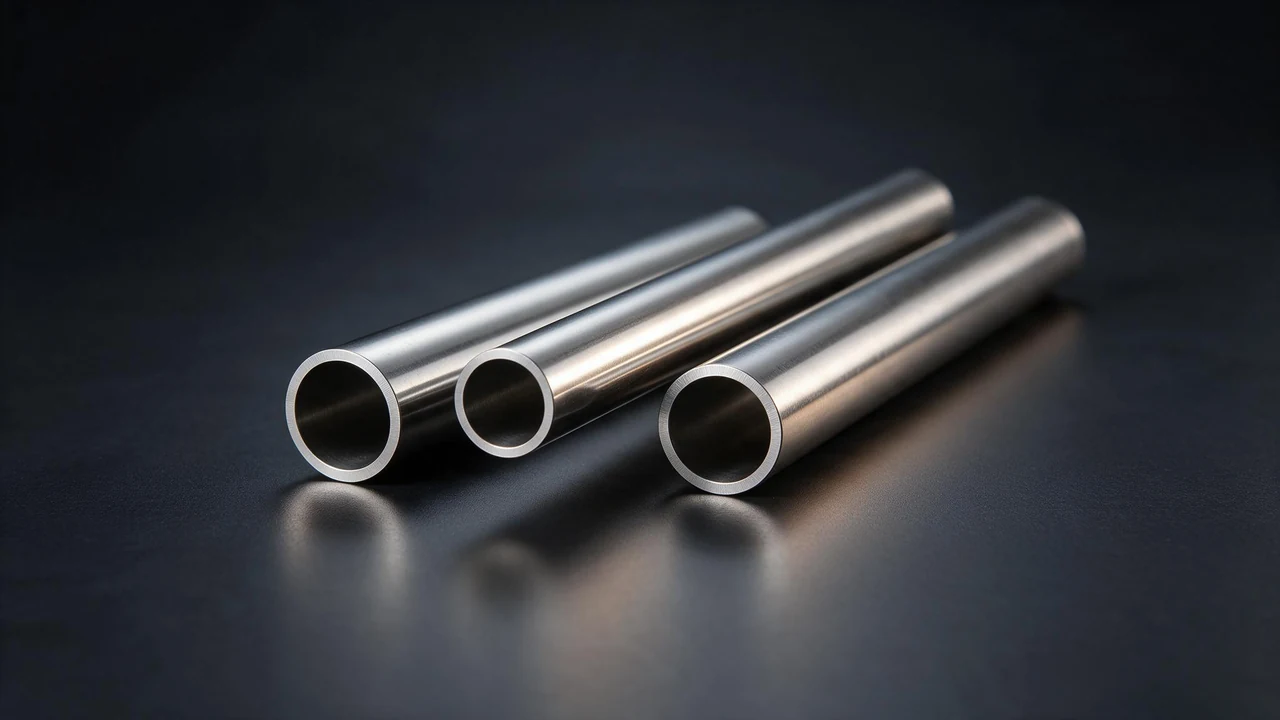
ASTM A312 TP316L is the low-carbon version of the 316 austenitic stainless steel pipe grade, with 16 to 18 percent chromium, 10 to 14 percent nickel, 2 to 3 percent molybdenum and carbon capped at 0.035 percent. The low carbon limits carbide precipitation at welded joints, so the pipe can be welded without post-weld solution annealing, at the cost of lower specified minimum strength.
Download ASTM A312 TP316L Pipe data sheet (PDF) One-page summary of the supply range, chemistry, mechanical properties and inspection documents on this page. The standard is the governing document.
Mejor Steel is the export agent for the mills that make your material: one contract, one delivery date, and the mill named on the quotation. How we supply
We reply within one business day, Monday to Friday 09:00-18:00 CST. Or write to info@mejorsteel.com / WhatsApp.
Size range and specification
- Outside diameter 1/8 inch – 24 inch (10.3 – 610 mm)
- Wall thickness SCH 5S – SCH 80S, or by wall thickness
- Length SRL 5.8 m, DRL 11.8 m, or fixed length
- Ends Plain end, beveled end, threaded
- Surface treatment Pickled, annealed and pickled, bright annealed, polished
- Delivery condition Annealed; welded pipe as-welded where the specification and the order allow
- Manufacturing process Seamless, welded, or heavily cold worked
- Heat treatment Solution annealed
- Delivery standard ASTM A312 / ASME SA312, dimensions to ASME B36.19M for the S schedules
How this grade is supplied
- Inspection Inspected by the producing mill’s own inspection department, which is independent of production, against the delivery standard above. Third-party inspection — SGS, BV or TUV, or an inspector you send yourself — can be arranged at the mill or before shipment; give us the dates and the scope at the order stage.
- Certificate A mill test certificate to EN 10204 3.1 showing the heat number, the chemical composition and the mechanical results is standard on every order. EN 10204 3.2, countersigned by the inspector you nominate, is available on request.
- Documents with the goods The mill test certificate and the packing list travel with the shipment, and the heat number is traceable from cast through to the finished product.
- Packing Sea-worthy export packing: bundled by size with end protection, corrosion protection on request, stencilled with the size, grade and heat number.
- MOQ One bundle or one truckload; mixed sizes within a bundle accepted.
- Lead time Counted from order confirmation, not from the enquiry. Stock sizes 5–10 days; mill run or non-stock 3–5 weeks. The delivery window is fixed on the quotation.
- How we supply Sourced through partner mills; the producing mill is named on the quotation.
ASTM A312 TP316L chemical composition (%)
| Element | Range | Element | Range |
|---|---|---|---|
| Carbon, C | 0.035 max | Nickel, Ni | 10.0 – 14.0 |
| Manganese, Mn | 2.00 max | Phosphorus, P | 0.045 max |
| Silicon, Si | 0.75 max | Sulphur, S | 0.030 max |
| Chromium, Cr | 16.0 – 18.0 | Molybdenum, Mo | 2.00 – 3.00 |
The composition is that of TP316 with one change: carbon is capped at 0.035 instead of 0.08 percent. The chromium forms the passive film that makes the steel stainless, the nickel holds the austenitic structure that gives it toughness at low temperature, and the molybdenum is what resists pitting and crevice corrosion in chloride service – none of which is affected by the carbon level. The carbon limit exists only to control what happens at a weld. There is no minimum carbon, so a mill may supply TP316L at 0.020 percent or lower, and a heat that satisfies the L grade automatically satisfies the standard grade on chemistry; it does not automatically satisfy it on strength, which is why a dual certified 316/316L heat has to meet the higher of the two strength requirements.
Source: chemical composition requirements of ASTM A312 / ASME SA312. The standard is the governing document.
ASTM A312 TP316L mechanical properties
| Grade | Tensile strength | Yield strength | Elongation | Hardness |
|---|---|---|---|---|
| TP316L (ASTM A312) | 485 MPa min (70,000 psi) | 170 MPa min (25,000 psi) | 35% min | not specified for the grade |
| TP316 (for reference) | 515 MPa min (75,000 psi) | 205 MPa min (30,000 psi) | 35% min | not specified for the grade |
| TP304L (for reference) | 485 MPa min (70,000 psi) | 170 MPa min (25,000 psi) | 35% min | not specified for the grade |
TP316L and TP304L are specified at the same minimum strength, so the choice between them is made on corrosion resistance and not on strength; TP316 is specified 30 MPa higher on tensile and 35 MPa higher on yield purely because of the extra carbon. Yield strength is the 0.2 percent offset value, as it is for all austenitic stainless steels. A312 does not specify a hardness limit for these grades, so no figure appears above; where sour service or a specific code applies, that limit governs and belongs on the order rather than being assumed from the grade.
Source: tensile requirements of ASTM A312 / ASME SA312. The standard is the governing document.
What Is ASTM A312 TP316L Pipe?
ASTM A312 TP316L is austenitic stainless steel pipe to the 316L composition: 16 to 18 percent chromium, 10 to 14 percent nickel, 2 to 3 percent molybdenum and carbon held to 0.035 percent maximum. The specified minimum tensile strength is 485 MPa (70,000 psi) and the minimum yield strength is 170 MPa (25,000 psi), both lower than the standard 316 grade because the carbon that would raise them is deliberately kept out. A312 covers seamless, welded and heavily cold worked pipe under the one specification, so the grade name does not say which route was used – a 2 inch SCH 40S seamless length and a 24 inch welded length carry the same designation. The pipe is supplied solution annealed, and the L grade is the one most often ordered where the pipe will be welded and cannot be re-annealed afterwards.
Why the Low Carbon Limit Exists
The reason for the 0.035 percent carbon ceiling is sensitization. When an austenitic stainless steel is held in roughly the 425 to 815 degree Celsius range – which is what happens in and beside a weld – any carbon in solution can combine with chromium to form chromium carbides at the grain boundaries. Those carbides take chromium out of the surrounding metal, and if the depleted zone falls below the level needed to keep the passive film stable, the grain boundaries become vulnerable to intergranular corrosion in a corrosive environment. Keeping carbon at or below 0.035 percent leaves too little carbon for that to happen to any significant degree. The alternative for a standard 316 weldment is to solution anneal after welding to redissolve the carbides, which is costly and often impossible on site – and that is the practical reason the L grade exists.
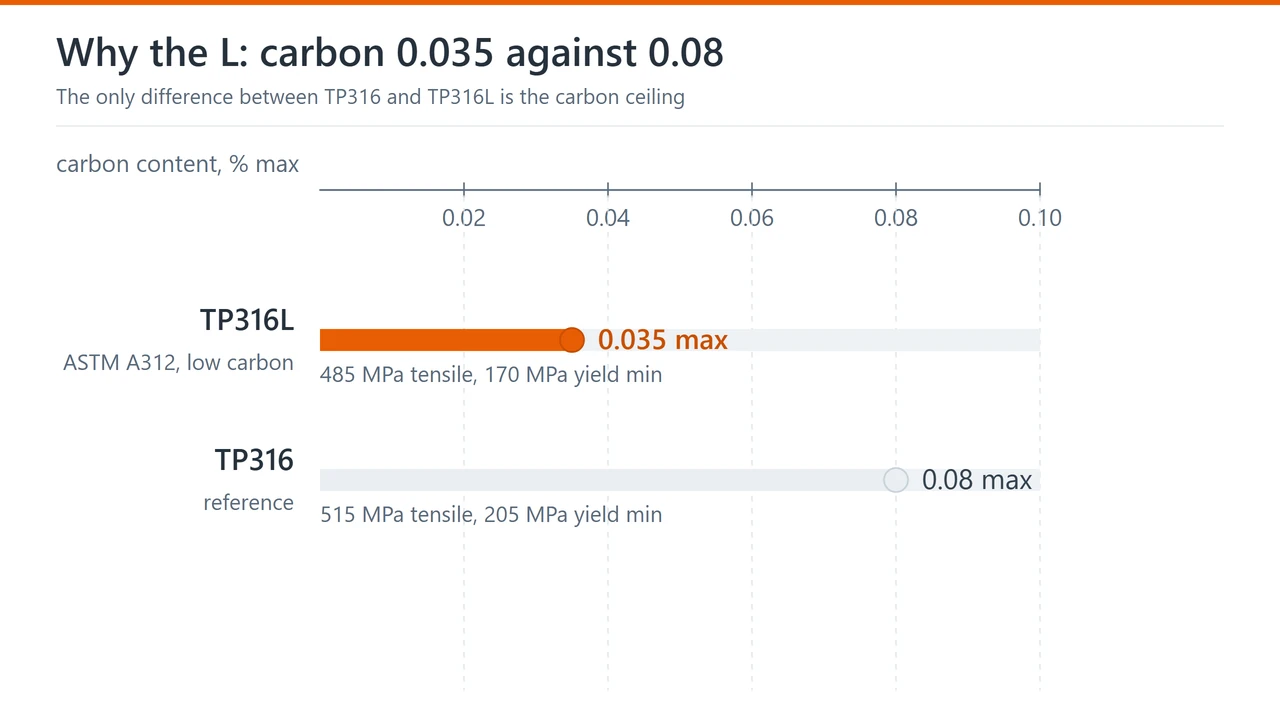
The only difference between the two grades is the carbon ceiling, which is shown below.
TP316L versus TP316: Which One Should Be Ordered?
TP316 and TP316L have the same chemistry except for carbon and the same corrosion resistance in service; the difference is what happens at a weld and what the pipe is specified to reach in strength. TP316L is specified where welded joints cannot be solution annealed afterwards – which covers most field welding – and where the piping specification calls for the low-carbon grade. TP316 is specified where the higher minimum strength matters, or where the joints will be annealed or are not welded at all. The strength gap is real but modest: 485 MPa against 515 MPa tensile, and 170 MPa against 205 MPa yield. Where a line carries both grades and the components are dual certified 316/316L, the material has to meet the higher numbers to satisfy both, and that is worth checking on the certificate.
TP316L versus TP304 and TP304L
TP316L and TP304L share the same low-carbon approach but not the same alloy. TP304L has 18 to 20 percent chromium and 8 to 11 percent nickel with no deliberate molybdenum; TP316L has 16 to 18 percent chromium, 10 to 14 percent nickel and 2 to 3 percent molybdenum. The molybdenum is the difference that matters, because it raises resistance to pitting and crevice corrosion in chloride-bearing water and process streams, and that is why TP316L is specified over TP304L wherever chlorides are present – the flange and fitting crevices in the same line being the places where the difference shows first. The two grades are specified at the same minimum tensile and yield strength, so the choice between them is entirely about the environment, not about strength or dimensions.
Sizes, Delivery Condition and Inspection
TP316L pipe is supplied from about 1/8 inch to 24 inch outside diameter, with dimensions to ASME B36.19M where a stainless S schedule is specified – the S schedules are thinner than the matching ASME B36.10M carbon steel schedules. Seamless pipe is furnished solution annealed and pickled, or bright annealed where the surface finish matters. Welded pipe may be supplied in the solution annealed condition or, where the specification and the order allow it, in the as-welded condition; the L grade is the one for which as-welded supply is most often accepted, because the low carbon removes most of the need for post-weld annealing. Documentation normally carries the mill certificate with chemistry and tensile results against the heat number and, where specified, an intergranular corrosion test to A262 and a hydrostatic or eddy current test on welded pipe.
What to state on the enquiry
TP316L is supplied seamless or welded, and the low-carbon grade is usually chosen for welding. These fields are required to quote without another round of questions:
- Manufacturing method: seamless or welded.
- Outside diameter, wall thickness or schedule, and length.
- Finish and tolerance: standard A312 finish, polished, or another surface requirement.
- Welding and heat-treatment condition: solution-annealed, with the weld area treated as required by the standard.
- Dual certification: TP316/TP316L, if the order allows it.
- Hydrostatic or non-destructive test requirement.
- Certificate level: EN 10204 3.1, or 3.2 with third-party countersignature.
- Quantity, destination port and Incoterms.
Do not assume every size and schedule is available in both seamless and welded. State the manufacturing method and schedule; if the size is non-standard, send the drawing or exact dimensional requirement.
Typical applications
- Chemical process piping carrying chlorides
- Pulp, paper and bleaching lines
- Offshore and coastal piping exposed to salt
- Food, pharmaceutical and high-purity systems
- Heat exchanger and condenser tubing
Standards covered
Sizes quoted most often in 316L, with the wall and the weight
The size in a 316L enquiry is an outside diameter plus a schedule, and for stainless the schedule comes from ASME B36.19M – the S series. The table gives the wall and the theoretical weight for the sizes quoted most often, so the enquiry, the quotation and the tally can be checked against one set of numbers.
| NPS | Outside diameter (mm) | SCH 10S wall (mm) | SCH 10S weight (kg/m) | SCH 40S wall (mm) | SCH 40S weight (kg/m) |
|---|---|---|---|---|---|
| 1/2 | 21.3 | 2.11 | 1.02 | 2.77 | 1.29 |
| 3/4 | 26.7 | 2.11 | 1.30 | 2.87 | 1.72 |
| 1 | 33.4 | 2.77 | 2.13 | 3.38 | 2.55 |
| 1 1/2 | 48.3 | 2.77 | 3.17 | 3.68 | 4.13 |
| 2 | 60.3 | 2.77 | 4.01 | 3.91 | 5.54 |
| 3 | 88.9 | 3.05 | 6.58 | 5.49 | 11.51 |
| 4 | 114.3 | 3.05 | 8.53 | 6.02 | 16.38 |
| 6 | 168.3 | 3.40 | 14.09 | 7.11 | 28.80 |
| 8 | 219.1 | 3.76 | 20.35 | 8.18 | 43.36 |
| 10 | 273.1 | 4.19 | 28.32 | 9.27 | 61.47 |
| 12 | 323.9 | 4.57 | 36.68 | 9.53 | 75.30 |
Walls are the ASME B36.19M S-schedule values listed on our pipe schedule chart. Weights are theoretical, calculated from W = 0.0246615 × t × (D − t) kg/m at the 316/316L density of 8.00 g/cm³ published on the weight calculator – for estimating, not for a shipping manifest.
Three numbers that are often left out of a 316L enquiry
Most delays on a 316L order come from three fields that look like details until the pipe is rolled.
- The schedule series. Stainless follows the S series: SCH 10S, 40S or 80S. A line that says “SCH 40” without the S describes a different wall, because the S schedules are thinner than the matching carbon steel schedules. Say both the number and the S.
- The finish. Annealed and pickled, bright annealed, or polished to a stated roughness. The finish decides how the surface behaves after welding and what the mill schedules. “Standard finish” is not a specification.
- The test route. Which tests are expected, and which certificate type. On A312 pipe the routine routes are hydrostatic testing and eddy current examination; where the service sits in the sensitising range, intergranular corrosion testing to ASTM A262 is specified alongside the grade, and the certificate type is stated as EN 10204 3.1 or 3.2. See the mill certificate guide for what each type has to show.
What has to be decided by the buyer rather than the mill is the corrosion assessment. The grade cannot be substituted by a thicker wall, and the same applies here: if the service sits outside what the molybdenum in 316L handles, the answer is a different alloy rather than a heavier schedule.
Frequently asked questions
How is the weight of a 316L pipe worked out?
From the outside diameter and the wall thickness: W = 0.0246615 × t × (D − t) gives kilograms per metre at the carbon steel density of 7.85 g/cm³, and the same expression scaled to the 316/316L density of 8.00 g/cm³ gives the weight for this grade. Take NPS 4 SCH 10S as an example: 114.3 mm outside diameter, 3.05 mm wall, about 8.53 kg/m. The weight calculator does the arithmetic for any size, and the table above lists the sizes quoted most often.
What is the difference between TP316 and TP316L?
Only the carbon content and, as a result, the specified minimum strength. TP316 allows up to 0.08 percent carbon and TP316L caps it at 0.035 percent. The lower carbon limits chromium carbide precipitation at the grain boundaries after welding, which is what makes a welded joint vulnerable to intergranular corrosion, so TP316L is used where the joint cannot be solution annealed afterwards. The trade-off is strength: TP316L is specified at 485 MPa minimum tensile and 170 MPa minimum yield against 515 and 205 for TP316. Corrosion resistance in service is the same.
Does TP316L need post-weld heat treatment?
In most service, no. The L designation exists because the low carbon keeps carbide precipitation at the weld low enough that a post-weld solution anneal is not needed, which is exactly why the grade is specified for field-welded lines. That is not an absolute rule: a specific code or a specific service may still require heat treatment or impose other conditions, and where the piping specification says so, it governs. The grade buys you the option of leaving the joint as-welded, not a blanket exemption from the design code.
Is TP316L weaker than TP316?
Yes, on the specified minimum values: 485 MPa tensile and 170 MPa yield for TP316L against 515 MPa and 205 MPa for TP316. The difference comes from carbon, which is what strengthens an austenitic stainless steel, and it is the deliberate price of the improved weldability. The gap is modest and in most piping design the wall is set by the design code allowable stress rather than by the difference between the two grades, but where strength is the governing factor the standard grade is the right choice.
What does 316/316L dual certification mean?
It means the heat is certified against both grades at once, which is done by keeping the carbon at or below 0.035 percent so that the L grade is satisfied on chemistry while the strength still reaches the standard grade requirement. Since TP316L is specified at 485 MPa tensile and 170 MPa yield while TP316 is specified at 515 and 205, a dual certified heat has to meet the higher figures. That is the point to check on the certificate: a heat marked 316/316L that only shows 485 and 170 does not satisfy the 316 part of the designation.
Where to go next
- Stainless Steel Pipe – grades, standards and how the order is fixed
- ASTM A312 TP316 Pipe – the molybdenum-bearing grade for chloride service
- ASTM A312 TP304 Pipe – the general-purpose austenitic stainless pipe grade
- ASTM A182 F316 Flange
- Oil & Gas – the four products in the oil and gas chain
- Pipe Schedule Chart – wall thickness for every schedule
- Get a Quote – send the grade, size, quantity and destination port
- ASTM A312 Stainless Steel Pipe – seamless and welded austenitic stainless pipe
- Stainless Steel Butt Weld Fittings – stainless butt weld fittings to ASME B16.9
- Boiler & Heat Exchanger Tube – tube specified by outside diameter and wall
Looking for a price on a specific item? We need the standard and grade, the size and wall thickness, the quantity, and the destination port. With those four we can confirm availability and give you a price.
Request a quotation