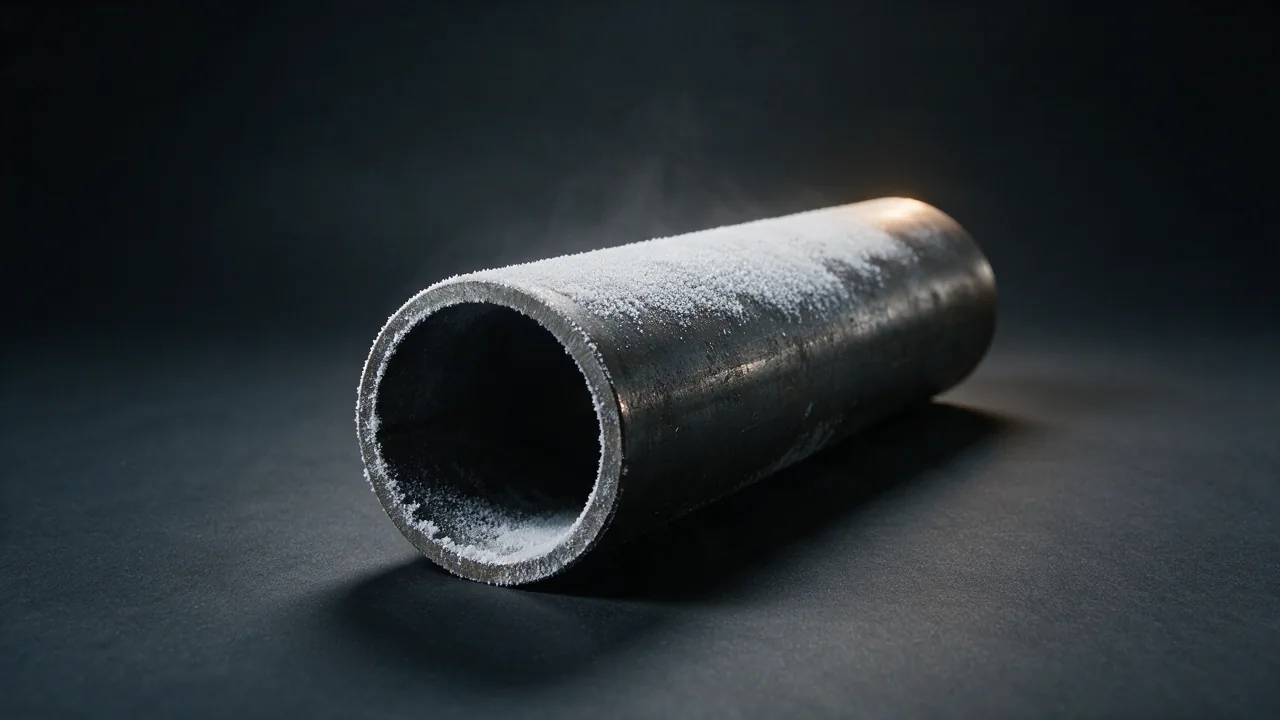
Low-temperature service is governed by impact toughness, not by strength. Below the ductile-to-brittle transition temperature steel can fail by brittle fracture at stresses well below its yield strength, so the material is not qualified by how strong it is but by a Charpy V-notch impact test carried out at the temperature it will actually see.

Mejor Steel is the export agent for the mills that make your material: one contract, one delivery date, and the mill named on the quotation. How we supply
We reply within one business day, Monday to Friday 09:00-18:00 CST. Or write to info@mejorsteel.com / WhatsApp.
Why strength is the wrong basis for selection
The usual instinct when a line has to work harder is to specify a higher grade. In low-temperature service that instinct is unsafe. Raising the yield strength of a carbon steel generally raises its transition temperature as well, moving the brittle-fracture risk up towards the operating range. The correct approach is to keep the strength modest, refine the grain, add nickel where necessary, and prove the toughness by testing at the design minimum temperature.
Three specifications that travel together
Low-temperature pipe is bought to ASTM A333, which covers seamless and welded steel pipe for low-temperature service and requires impact testing on every grade. Its companions are ASTM A420 for wrought carbon and alloy steel fittings — grades WPL6, WPL9 and WPL3 are the ones normally seen — and ASTM A350 for forgings, where LF2 is the grade that most low-temperature flanges are made from. Specifying one without the other two leaves a line whose pipe is qualified for the cold and whose fittings are not.
The grades, and how cold they go
Nickel is what buys temperature. Grade 1 and Grade 6 are plain carbon-manganese steels and are impact tested at −45 °C. Grade 3 adds nominally 3.5% nickel and is impact tested at −100 °C (−150 °F). Grade 8 uses nominally 9% nickel and reaches −195 °C, which is the range occupied by liquefied natural gas and liquid nitrogen. Impact testing is mandatory for every grade, with a typical full-size acceptance of 18 J average and no single specimen below 14 J.
| Service need | Product | Standard and grade |
|---|---|---|
| Low-temperature pipe | ASTM A333 Low Temperature Steel Pipe | ASTM A333 Grade 1, 3, 6, 8; impact tested to the specification |
| Cryogenic and LNG lines | ASTM A312 Stainless Steel Pipe | ASTM A312 TP304 / 304L, TP316 / 316L for cryogenic service |
| Impact-tested line pipe | API 5L Seamless Steel Pipe | API 5L PSL2 with low-temperature Charpy impact testing |
| Large-diameter low-temperature lines | API 5L LSAW Welded Steel Pipe | API 5L PSL2, impact tested at the design minimum temperature |
| Low-temperature fittings | Alloy Steel Fittings | ASTM A420 WPL6, WPL9, WPL3 |
| Stainless fittings for cryogenic service | Stainless Steel Butt Weld Fittings | ASTM A403 WP304 / WP316, to the pipe specification |
| Low-temperature flanges | Pipe Flanges | ASTM A350 LF2 / LF3, or A182 F304 / F316 for austenitic |
| Elbows, tees and reducers | Butt Weld Elbow | ASME B16.9, ASTM A420 WPL6 |
| Coated and insulated cold lines | Anti-Corrosion Coated Steel Pipe | External coating and insulation to the project specification |
The design code sets the requirement
The question of whether impact testing is required, and at what temperature, is answered by the design code rather than by the material specification. For process piping, ASME B31.3 sets the minimum design metal temperature and the impact test requirements that follow from it; for pressure vessels it is ASME Section VIII. The A333 grades carry their own impact testing as part of the specification, which is why they are the straightforward answer where the design temperature is low.
- Give the minimum design metal temperature. Everything about the material choice follows from it.
- Do not upgrade the grade to solve a cold problem. Higher strength generally means a higher transition temperature.
- Specify the fittings and flanges to match. A333 pipe with ordinary A234 WPB fittings is an unqualified joint.
- State the impact test temperature explicitly. It is a separate requirement from the grade and is priced separately.
- Ask for the impact test report. The qualification is the test result, not a claim on a certificate.
- Consider the whole assembly. Welds, heat-affected zones and supports all sit in the cold, not just the pipe body.
Frequently asked questions
What makes steel suitable for low-temperature service?
Impact toughness rather than strength. The steel has to resist brittle fracture at the minimum design metal temperature, which is demonstrated by a Charpy V-notch impact test at or below that temperature. Nickel is added, and the microstructure is refined, to move the ductile-to-brittle transition below the service temperature.
What is the difference between ASTM A333 Grade 1, 3 and 6?
Grade 1 and Grade 6 are carbon-manganese steels impact tested at −45 °C. Grade 3 contains nominally 3.5% nickel and is impact tested at −100 °C (−150 °F), so it is chosen where the design temperature is below what a plain carbon steel can be qualified for. Grade 8, at nominally 9% nickel, extends the range to −195 °C.
Which fittings and flanges go with A333 pipe?
ASTM A420 for wrought carbon and alloy steel fittings, commonly grades WPL6, WPL9 and WPL3, and ASTM A350 for forgings, usually LF2 for flanges. The three specifications are written as a family, and mixing a low-temperature pipe with standard-temperature fittings leaves the joint unqualified.
Why is a higher grade not the answer for cold service?
Because strength and toughness pull in opposite directions in carbon and low-alloy steels. Increasing the yield strength tends to raise the ductile-to-brittle transition temperature, which reduces the margin against brittle fracture. The low-temperature grades are chosen for toughness at the design temperature, and their yield strength is a consequence of that choice.
Where to go next
- Steel pipe weight calculator – work out the weight of any size and wall thickness
- Pipe schedule chart – wall thickness for every schedule, carbon and stainless
- Request a quotation – send the specification, quantity and destination port
- ASTM A333 Grade 3 pipe – the 3.5% nickel low-temperature grade
- ASTM A333 low temperature steel pipe – grades, temperature range and impact testing
- Sour service – the other condition that overrides a strength-based selection
- Pipeline transmission – how transmission lines are specified and coated
Four details and we can quote. The grade or the standard the material has to meet, the size and wall thickness, the tonnage, and the destination port. Send them together and we answer with availability and pricing.