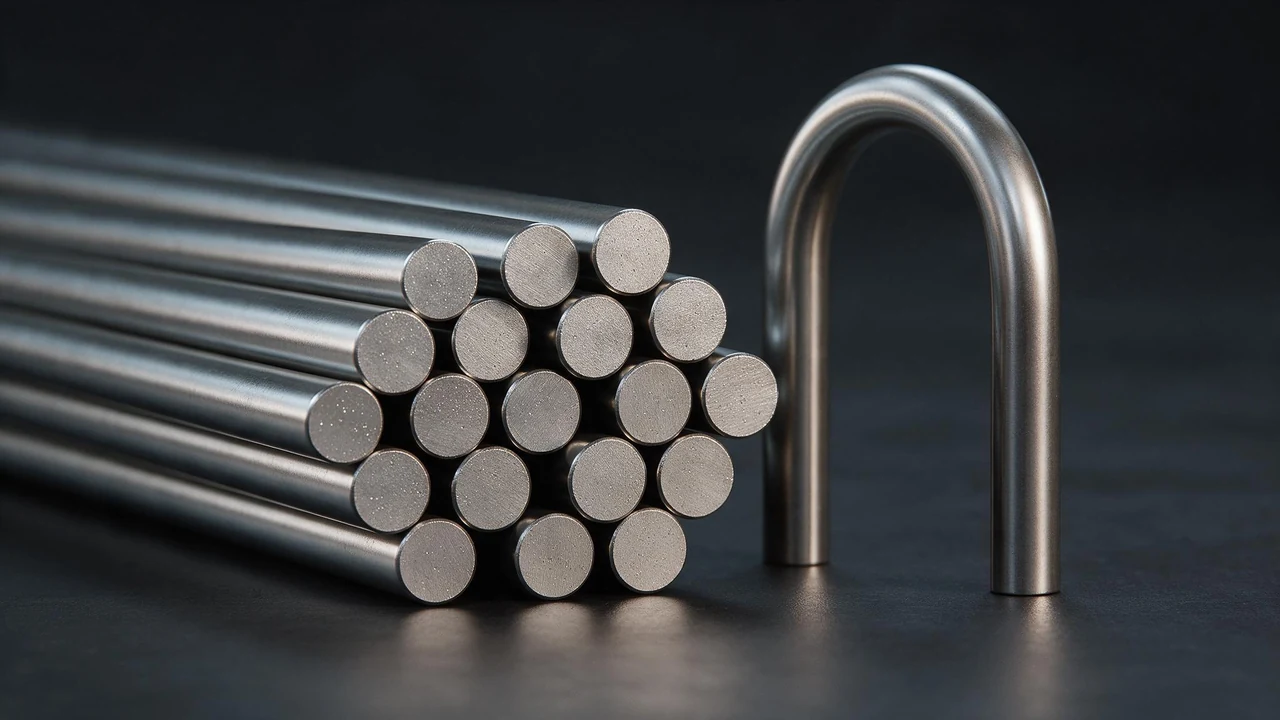
ASTM A213 T11 is a seamless 1.25 percent chromium, 0.5 percent molybdenum alloy steel tube for boiler, superheater and heat exchanger service, with a minimum tensile strength of 415 MPa and a minimum yield strength of 205 MPa. It carries the same nominal chemistry as A335 P11 pipe but is made to tube tolerances and ordered by outside diameter, wall thickness and minimum or average wall.
Download ASTM A213 T11 Alloy Steel Tube data sheet (PDF) One-page summary of the supply range, chemistry, mechanical properties and inspection documents on this page. The standard is the governing document.
Mejor Steel is the export agent for the mills that make your material: one contract, one delivery date, and the mill named on the quotation. How we supply
We reply within one business day, Monday to Friday 09:00-18:00 CST. Or write to info@mejorsteel.com / WhatsApp.
Size range and specification
- Outside diameter 1/2 inch – 5 inch (12.7 – 127 mm), or by outside diameter
- Wall thickness 0.9 – 12.7 mm (0.035 – 0.500 inch); ordered as minimum wall or average wall
- Length SRL 5.8 m, DRL 11.8 m, or fixed length; U-bent on request
- Ends Plain end, beveled end
- Surface treatment Pickled, black, oiled, or as specified
- Delivery condition Annealed; hot finished or cold drawn and heat treated
- Manufacturing process Seamless, hot finished or cold drawn
- Heat treatment Annealed; cold drawn tube is heat treated after the final drawing pass
- Delivery standard ASTM A213 / ASME SA213, general requirements to A1016 / SA1016
How this grade is supplied
- Inspection Inspected by the producing mill’s own inspection department, which is independent of production, against the delivery standard above. Third-party inspection — SGS, BV or TUV, or an inspector you send yourself — can be arranged at the mill or before shipment; give us the dates and the scope at the order stage.
- Certificate A mill test certificate to EN 10204 3.1 showing the heat number, the chemical composition and the mechanical results is standard on every order. EN 10204 3.2, countersigned by the inspector you nominate, is available on request.
- Documents with the goods The mill test certificate and the packing list travel with the shipment, and the heat number is traceable from cast through to the finished product.
- Packing Sea-worthy export packing: bundled by size with end protection, corrosion protection on request, stencilled with the size, grade and heat number.
- MOQ One bundle or one truckload; mixed sizes within a bundle accepted.
- Lead time Counted from order confirmation, not from the enquiry. Stock sizes 5–10 days; mill run or non-stock 3–5 weeks. The delivery window is fixed on the quotation.
- How we supply Sourced through partner mills; the producing mill is named on the quotation.
ASTM A213 T11 chemical composition (%)
| Element | Range | Element | Range |
|---|---|---|---|
| Carbon, C | 0.05 – 0.15 | Chromium, Cr | 1.00 – 1.50 |
| Manganese, Mn | 0.30 – 0.60 | Molybdenum, Mo | 0.44 – 0.65 |
| Phosphorus, P | 0.025 max | Silicon, Si | 0.50 – 1.00 |
| Sulphur, S | 0.025 max | Nickel, Ni | not specified |
The chromium and molybdenum ranges are what carry the high-temperature strength: 1.00 to 1.50 percent chromium and 0.44 to 0.65 percent molybdenum put T11 between the plain carbon grades and the 2.25Cr-1Mo T22 grade, and the chromium is also what forms the oxide that resists steam-side scaling. Carbon is held to a narrow 0.05 to 0.15 percent band so that the tube stays weldable and tough, and phosphorus and sulphur are capped because both reduce creep ductility at temperature. The silicon range is wide because silicon is both a deoxidizer and an oxidation aid. ASTM A213 T11 and ASTM A335 P11 carry the same nominal chemistry, so a heat may be dual certified, but the two specifications apply their own product analysis tolerances and their own test requirements, which is why an A213 certificate and an A335 certificate are not interchangeable documents even when the chemistry matches.
Source: chemical composition requirements of ASTM A213 / ASME SA213. The standard is the governing document.
ASTM A213 T11 mechanical properties (annealed)
| Grade | Tensile strength | Yield strength | Elongation | Hardness |
|---|---|---|---|---|
| T11 (ASTM A213) | 415 MPa min (60,000 psi) | 205 MPa min (30,000 psi) | 30% min | 163 HBW max |
The room-temperature requirements above are the ASTM A213 values for Grade T11. Elongation is tabulated in A213 against wall thickness and specimen type rather than as a single figure, so a thin-wall heat exchanger tube and a heavy-wall superheater tube do not carry the same minimum, and the number on the mill certificate has to be read against the table row that matches the specimen actually used. The hardness limit is a check on heat treatment rather than a strength requirement: a cold drawn tube that was not properly annealed shows up as hardness above the limit. The stresses used to design a superheater bank or a steam line are the elevated-temperature allowable stresses of ASME B31.1 and ASME Section II Part D, not the room-temperature values above.
Source: tensile requirements of ASTM A213 / ASME SA213. The standard is the governing document.
What Is ASTM A213 T11 Tube?
ASTM A213 T11 is a seamless ferritic alloy steel tube made to the 1.25Cr-0.5Mo composition for boiler, superheater and heat exchanger service. Its minimum tensile strength is 415 MPa (60,000 psi) and its minimum yield strength is 205 MPa (30,000 psi), and it is supplied annealed. T11 is the tube-grade member of the 1.25Cr-0.5Mo family: the same alloy is called T11 under the tube specification ASTM A213 and P11 under the pipe specification ASTM A335, and the two appear together on the same boiler, with T11 tubes forming the superheater banks and P11 pipe forming the headers and connecting steam lines. A213 covers ferritic alloy tubes in a narrow dimensional band, typically 1/2 inch to 5 inch outside diameter, and a 2 inch outside diameter tube is ordered by outside diameter and wall thickness rather than by nominal pipe size.
How Does T11 Tube Differ from A335 P11 Pipe?
The alloy is nominally the same – about 1.25 percent chromium and 0.5 percent molybdenum – so the real difference between T11 and P11 is the product form and the dimensional and testing regime, not the chemistry. T11 is a tube: made to ASTM A213, measured by outside diameter and wall thickness, held to tube tolerances, and ordered wall by wall, often as minimum wall for a heat exchanger. P11 is a pipe: made to ASTM A335, sized to the ASME B36.10M schedules by nominal pipe size, and measured with pipe tolerances. The two specifications also test differently. A213 sets its own elongation values against wall thickness and specimen type, which is what matters on thin-wall tube, and it applies a hardness limit as a check on annealing. A buyer comparing the two grades on chemistry alone will see no difference and will miss the tolerance and test differences that decide the order.
Minimum Wall or Average Wall: Which Should Be Ordered?
ASTM A213 allows the wall thickness of a tube to be ordered either as a minimum wall or as an average wall. Minimum wall is the conservative choice and the one used for pressure parts: the figure on the order is a floor that no measurement may fall below, so the mill has to aim above it and the permitted tolerance runs in the plus direction. Average wall means the average of the wall measurements taken around and along the tube must sit within a tolerance band around the nominal figure, so individual readings can and do fall below the nominal wall. Average wall is used where the tube is bought against a weight or a heat transfer calculation rather than a pressure calculation. The order must say which is wanted, because the same nominal figure ordered as average wall delivers a thinner and lighter tube than the same figure ordered as minimum wall.
Where T11 Tube Is Used, and What Sits Above and Below It
T11 is used for superheater and reheater tube banks, boiler convection and economizer sections, and heat exchanger and air heater tubing; it also appears in small-diameter high-temperature lines such as steam sample and soot blower piping. Below it sit the carbon grades – A179 for low-pressure heat exchangers, A192 and A210 for boiler tubes – which are limited by creep and by oxidation at the top of their range. Above it sit the higher-chromium grades: T22 (2.25Cr-1Mo) for hotter superheater sections, and T9 and T91 for the hottest metal temperatures in modern boilers. Published guidance generally places the working range of the 1.25Cr-0.5Mo composition at roughly 450 to 565 degrees Celsius, the exact limit being set by the allowable stress the design code tabulates at the design temperature rather than by the grade itself.
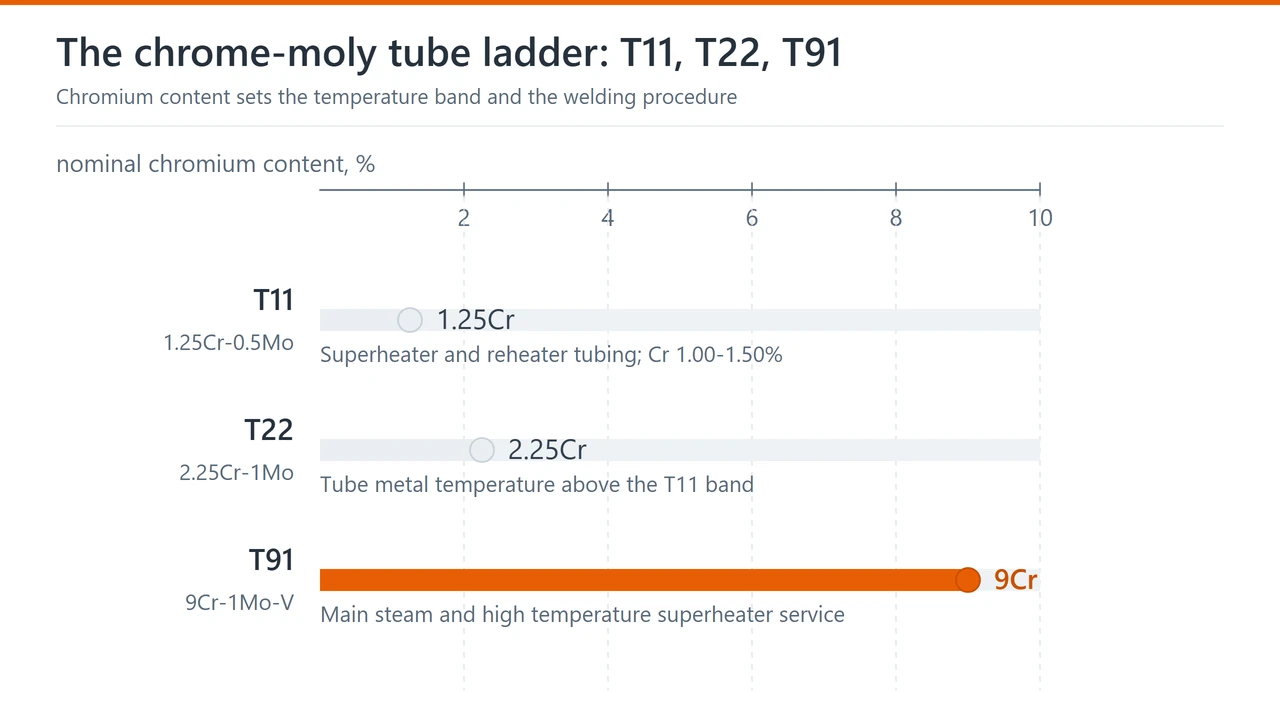
T11, T22 or T91: what the choice turns on
All three grades have the same specified minimum yield strength of 205 MPa (30,000 psi) at room temperature, so the choice is not about strength on paper. It is about the metal temperature the design code allows the composition to carry, and about how much welding and heat treatment the job can support.
| Grade | Composition | Where it is normally chosen | What moves when you step up |
|---|---|---|---|
| T11 | 1.25Cr-0.5Mo | Superheater and reheater tubing, economiser and convection sections in the lower part of the alloy band | Lowest alloy content of the three; annealed and supplied against a 163 HBW maximum |
| T22 | 2.25Cr-1Mo | Tube metal temperature above the T11 band, and headers or tubes that have to share one specification | More chromium and molybdenum, so a higher material price per tonne and a tighter welding procedure |
| T91 | 9Cr-1Mo-V | Main steam and high temperature superheater service, and where the design wants a thinner wall for the same pressure | Controlled preheat and interpass temperature and post weld heat treatment are mandatory, not optional; consumables and heat treatment records have to match |
The chemistry of each grade is on its own page: ASTM A335 P22 and ASTM A335 P91 give the composition and mechanical tables used here for comparison. The allowable stress that actually sizes the tube is tabulated by the design code, so the temperature at which a design must step from T11 to T22 is fixed by that code, not by this page.
Chromium content is what moves the three grades apart, and the ladder is shown below.
What changes in the order when you step up a grade
- Welding procedure: T11 welds like a low alloy steel, T91 does not. Preheat, interpass temperature and post weld heat treatment have to be written into the procedure before the tubes are welded.
- Heat treatment records: for all three grades the annealed or normalised and tempered condition is what the certificate reports, and a project that checks hardness is checking whether the heat treatment actually happened.
- Hardness limits: the ferritic grades carry a maximum hardness because a tube that missed its heat treatment will still test to strength but not to hardness.
- Inspection: third party inspection at the mill is arranged the same way for all three; what changes is the scope, because a P91 order usually carries more welding documentation.
U-bent T11 tubes: what the bend changes
U-bent tubes are bent to the customer’s drawing rather than to a catalogue radius. Three items have to be fixed before the tubes are made:
- Bend radius and straight leg length, taken from the drawing, on both legs.
- Whether a stress relief heat treatment is required after bending. This depends on the bend radius and on the design code; state it on the order so the tubes are not packed before the question is closed.
- Whether the bent tube has to be hydrostatically tested or inspected after bending, and who witnesses it.
Bend geometry is taken from the customer drawing. Post bend heat treatment and testing are confirmed against the design code and the purchase order before production starts.
Heat Treatment, Hardness and What the Mill Certificate Should Show
A213 tube is supplied annealed. Cold drawn tube is heat treated after the final drawing pass, which is what restores ductility and brings the hardness down; hot finished tube is supplied as finished. That is why A213 applies a hardness limit to the ferritic alloy grades – a tube that was not properly annealed shows up as hardness above the limit, so hardness is a heat treatment check rather than a strength requirement. Documentation for T11 tube normally carries the heat number, the chemical analysis, the tensile results with the specimen size, the hardness result and the heat treatment record. Where the tube is destined for a heat exchanger, the order usually adds either a hydrostatic test or an eddy current test, and the certificate should then be checked for the test method and the acceptance level that were specified.
Typical applications
- Superheater and reheater tube banks
- Boiler convection and economizer tube sections
- Heat exchanger and air heater tubing
- Steam sample and soot blower lines
- Small-diameter high-temperature steam and process lines
Standards covered
Frequently asked questions
Is ASTM A213 T11 the same as A335 P11?
The alloy is the same – about 1.25 percent chromium and 0.5 percent molybdenum – but the product and the specification are different. T11 is tube made to ASTM A213 and ordered by outside diameter and wall thickness, while P11 is pipe made to ASTM A335 and sized to the ASME B36.10M schedules. The two use different test specimens and different elongation tables, so the certificates are not interchangeable even when the chemistry matches.
What is the difference between minimum wall and average wall tube?
Minimum wall makes the ordered figure a floor: no measurement of wall thickness may fall below it, so the tolerance is all plus. Average wall applies the tolerance to the average of the measurements, so an individual reading can sit under the nominal wall. A tube ordered as average wall is therefore thinner and lighter than the same nominal tube ordered as minimum wall, which is why the minimum wall callout is the normal one for pressure parts.
What is the maximum service temperature for A213 T11?
There is no single number. The limit is the allowable stress the design code tabulates for this composition at the design temperature, so it depends on the code and on the wall thickness, and published guidance for 1.25Cr-0.5Mo generally falls in the 450 to 565 degrees Celsius band. Above that range the allowable stress has fallen far enough that a designer normally steps up to T22 or to a 9 percent chromium grade. The design metal temperature and the applicable code, not the tube, decide the answer.
Is A213 T11 tube seamless or welded?
The ferritic alloy grades of A213, which include T11, are seamless. A213 also covers welded austenitic stainless tubes, but those are a separate part of the specification and are not interchangeable with T11. If a welded tube is offered against a T11 enquiry, the offer is for a different product and should be treated as such.
What is the difference between A213 T11 and T22?
Both are seamless ferritic alloy tubes with the same specified minimum tensile strength of 415 MPa (60,000 psi) and the same minimum yield strength of 205 MPa (30,000 psi), so the choice is not made on room temperature strength. T11 is the 1.25Cr-0.5Mo composition; T22 is the 2.25Cr-1Mo composition. The extra chromium and molybdenum in T22 raise the allowable stress at temperature, which is what allows it to be used where the design code does not permit T11 at the tube metal temperature of the project. Where the design temperature does allow T11, T22 costs more for no benefit; where the code has already moved past the T11 band, T22 is not an upgrade but a requirement. The comparison table and the order changes that go with it are in the section above, and the pipe equivalent of T22 is described on the ASTM A335 P22 page.
Where to go next
- ASTM A335 P11 Alloy Steel Pipe
- ASTM A210 Grade A1 Boiler Tube
- ASTM A179 Heat Exchanger Tube
- Boiler & Heat Exchanger – tube and pipe for boilers and heat exchangers
- Pipe Schedule Chart – wall thickness for every schedule
- Get a Quote – send the grade, size, quantity and destination port
- Boiler & Heat Exchanger Tube – tube specified by outside diameter and wall
- ASTM A335 Alloy Steel Pipe – alloy steel pipe for high-temperature service
- Alloy Steel Fittings – alloy fittings for high-temperature service
- ASTM A519 Mechanical Tubing – seamless carbon and alloy tube for machining, not pressure
Four details and we can quote. The grade or the standard the material has to meet, the size and wall thickness, the tonnage, and the destination port. Send them together and we answer with availability and pricing.
Request a quotation